By insideSail
Automated technical check · version 2 ·
Privacy and circulation: live through the layout
Doors, routes and schedules reveal more than berth count.
In this guide
A plan presents spaces simultaneously, while a family uses them over time. That difference explains why two cabins may serve one routine better than three without creating a rule that fewer is always better.
Add people, tasks and schedules to deepen the comparison. Ask not only how many can sleep, but who can rest, pass through, prepare food, store clothing or reach the heads without reorganising the interior each time.
A layout becomes more understandable when its apparent capacity is tested against a day rather than a maximum sleeping count.
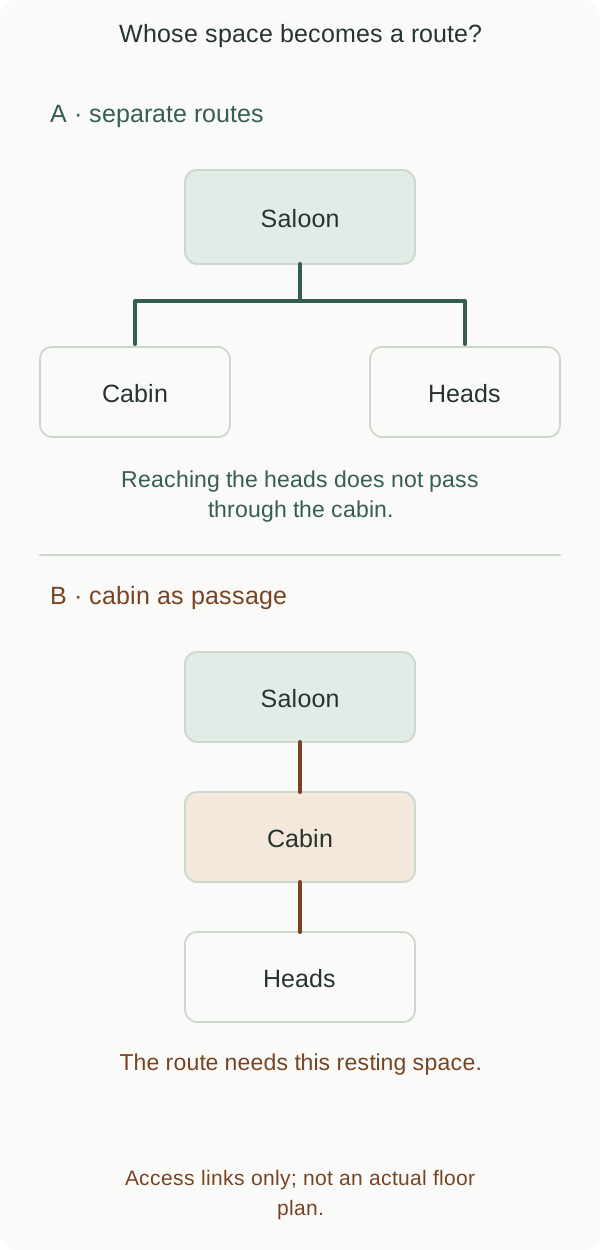
Access links only; not an actual floor plan.
insideSailOriginal insideSail artwork — all rights reservedEnlarge the diagram
Three different kinds of privacy
Visual privacy concerns being outside the direct sightline of passing people. Circulation privacy concerns whether a resting space is also a necessary route.
Acoustic privacy depends on construction, doors, equipment and conditions absent from a simple plan. An enclosed cabin may address the first question while leaving the others open.
Keep those dimensions separate. A drawn line proves no sound insulation, and distance between berths establishes no quiet night.
This distinction also explains why a private heads compartment and a genuinely private cabin are related features rather than interchangeable descriptions.
Turn the plan into an access network
Represent each space with a rectangle and each documented passage with a connection. Cockpit, saloon, cabins and heads become a readable network.
In fictional A, both aft cabin and heads connect independently to the saloon, so the heads route does not cross the cabin. In fictional B, reaching the heads goes through the cabin.
These are access diagrams, not plans of real boats. Two neighbouring door symbols do not establish a passage; the connection needs evidence.
A graph can simplify this question precisely because it leaves decorative details and uncertain dimensions out.
Now assign tasks. At seven, one person sleeps, another prepares breakfast and a third retrieves clothing.
At night, reaching the heads may switch on a light near someone resting. The exercise reveals overlapping use rather than measuring comfort.
A saloon berth may suit an occasional visitor and be inconvenient for your daily routine. The same arrangement can therefore receive different assessments because the briefs differ, not because one family misunderstands boats.
Include storage access in the scenario: retrieving a bag from beneath an occupied berth is a different task from opening a separate locker.
Berths, cabins and stowage need separate fields
A cabin may contain several sleeping places, while advertised berths may depend on converting the saloon. Identify permanence, access and dimensions rather than treating “double” as a universal size.
Stowage also has independent value. ORC records living, sleeping and personal-storage areas as separate accommodation aspects.
Its racing rules do not supply a family-habitability classification; they simply illustrate why the information cannot collapse into cabin count. A berth with a narrow access and a berth reached from both sides remain different arrangements even when both are advertised for two people.
As a real documentation example, the official Oceanis 37.1 page presents several layouts, including two cabins with one heads compartment and three with two. That confirms options rather than acoustic privacy or the layout of an advertised individual boat.
Identify the version from the official record, then ask about doors, circulation, access and use. An editorial comparison should describe the routine favoured and the evidence still missing, rather than presenting “family layout” as a certification or assuming that the most photographed configuration is universal.
- Separate visual, circulation and acoustic privacy.
- Test a concrete routine with people and schedules.
- A model option does not establish an individual boat’s configuration.
Sources and references
- Oceanis 37.1 — variants, layouts and specifications ↗
BENETEAU · Available in 2 versions; Specifications disclaimer; Layout plans, 2 cabins/1 shower room and 3 cabins/2 shower rooms; Water Capacity/Fuel Capacity.
Official live sections read. Only existence of different documented layouts/configurations supports examples; US prices, marketing adjectives and inferred actual usable volume excluded.
Checked on - Accommodation — separate fields ↗
Offshore Racing Congress · Fundamental Requirements: living/sleeping areas, access, headroom and stowage recorded separately.
Public selected paragraph/list read. Racing accommodation rules are not a universal cruising standard, legal approval or a privacy assessment.
Checked on
Keep discovering
The next piece of the puzzle
Discuss this concept
Loading the conversation…