By insideSail
Automated technical check · version 2 ·
Reading a design: the compromises behind its label
Turn cruiser or performance into a set of comparable questions.
In this guide
A label such as cruiser describes a broad intention without explaining every design choice. Two boats presented that way may offer very different experiences.
Read each as a response to a brief: who uses it, for how long, under what conditions and with which priorities. Begin by asking what the design favours rather than whether it belongs on the correct side of an imagined divide between fast and comfortable boats.
A useful comparison examines several connected decisions instead of treating the category as a verdict.
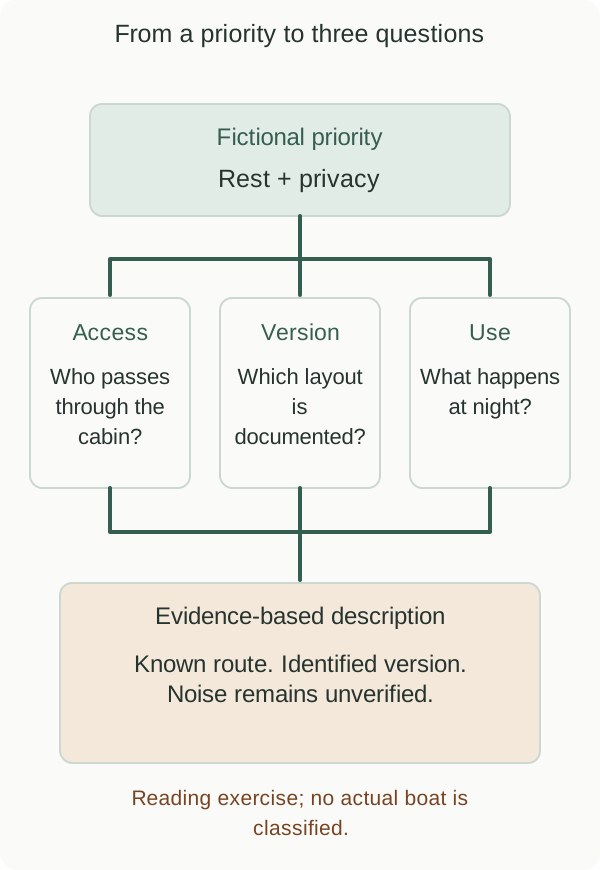
Reading exercise; no actual boat is classified.
insideSailOriginal insideSail artwork — all rights reservedEnlarge the diagram
The brief comes before the component list
Write down three moments in your intended use. A family might imagine preparing food with everyone aboard, sleeping while the saloon remains available, and sailing for an afternoon with two people.
Someone else may value club racing and spend few nights aboard. Neither brief independently identifies a suitable boat.
It orders questions about space, effort, access and resources. A choice may help during one moment and create a compromise during another; making that relationship explicit produces a more useful comparison than collecting desirable adjectives.
Equal dimensions do not mean equal shapes
Length and beam matter, but do not describe volume distribution, sectional shape or the whole surface touching the water. The ORC explains why its analysis needs hull geometry alongside individual measurements.
Equal maximum beams may occur at different positions and accompany different interiors. A waterline quoted for one condition is not a complete description of a loaded boat.
Identify the condition and geometry before interpreting the number. Drawing two rectangles with equal length and width can be a useful reminder: those rectangles still leave the hull form almost entirely unspecified.
Choices interact without producing automatic outcomes. Interior space, stowage, system access and deck organisation compete within finite space.
A bulkhead or equipment position may affect more than its immediate compartment. A plan alone establishes neither structural strength, motion comfort nor steering ease.
The exercise is to recognise connections and distinguish an editorial hypothesis from an outcome requiring documentation, assessment or contextual experience. A larger room on paper may coexist with a narrower passage; the drawing can reveal that question without deciding whether either arrangement is acceptable for a particular person.
A design promise is an attributed source
J/Boats describes the J/112E through a dual-purpose brief and sailing-comfort priorities. That is evidence of stated design and commercial intentions rather than an independent assessment of every individual boat.
Separate a documented feature, the consequence proposed by its maker and the question still open. Apply the same method to every manufacturer.
A brochure is useful when its role is visible; it becomes misleading when one brand’s explanation is silently converted into a universal law of naval architecture or an editorial ranking.
Retain compromises without inventing a score
A comparison can end with “favours this routine, with these unresolved questions”. That is more informative than a number mixing space, speed and safety without public criteria.
Preferences can also change: moving from weekends to longer holidays changes the brief rather than the hull facts. Keep those layers separate.
For real models, identify version, source and condition; for owner experience, add the reported context. A compromise remains useful information even when it cannot be converted into a score.
This approach deepens a decision while preserving uncertainty instead of manufacturing confidence from an incomplete specification.
- A brief turns adjectives into specific questions.
- Shape, arrangement and condition complement isolated measurements.
- Manufacturer intention, editorial analysis and experience are different kinds of evidence.
Sources and references
- J/112E — Family Sport Cruising ↗
J/Boats · Dual Purpose; Designed to Sail; selected design intentions, not asserted performance.
Official manufacturer page read. Marketing claims are attributed intentions, not independent proof; wind ranges, speed promises and safety superlatives excluded.
Checked on - Hull geometry ↗
Offshore Racing Congress · Opening paragraphs: volume distribution, wetted surface and full hull geometry versus a few dimensions.
Public explanatory page read. No proprietary offset file, software, copied figure or claimed VPP result obtained.
Checked on
Keep discovering
The next piece of the puzzle
Discuss this concept
Loading the conversation…