By insideSail
Published without technical review · version 2 ·
Rudders: five drawings and two classification axes
Rudder support and rudder count are different information.
In this guide
One specification says twin rudders and another spade rudder. Those labels do not exclude each other: the first counts rudders and the second describes a support arrangement.
Keep those axes separate in the platform. The drawing identifies the blade interacting with water, the stock transmitting loads and visible supporting elements.
Its outline is educational. It represents neither component strength nor steering-system quality.
Begin with what is present, then ask which evidence describes construction and condition.
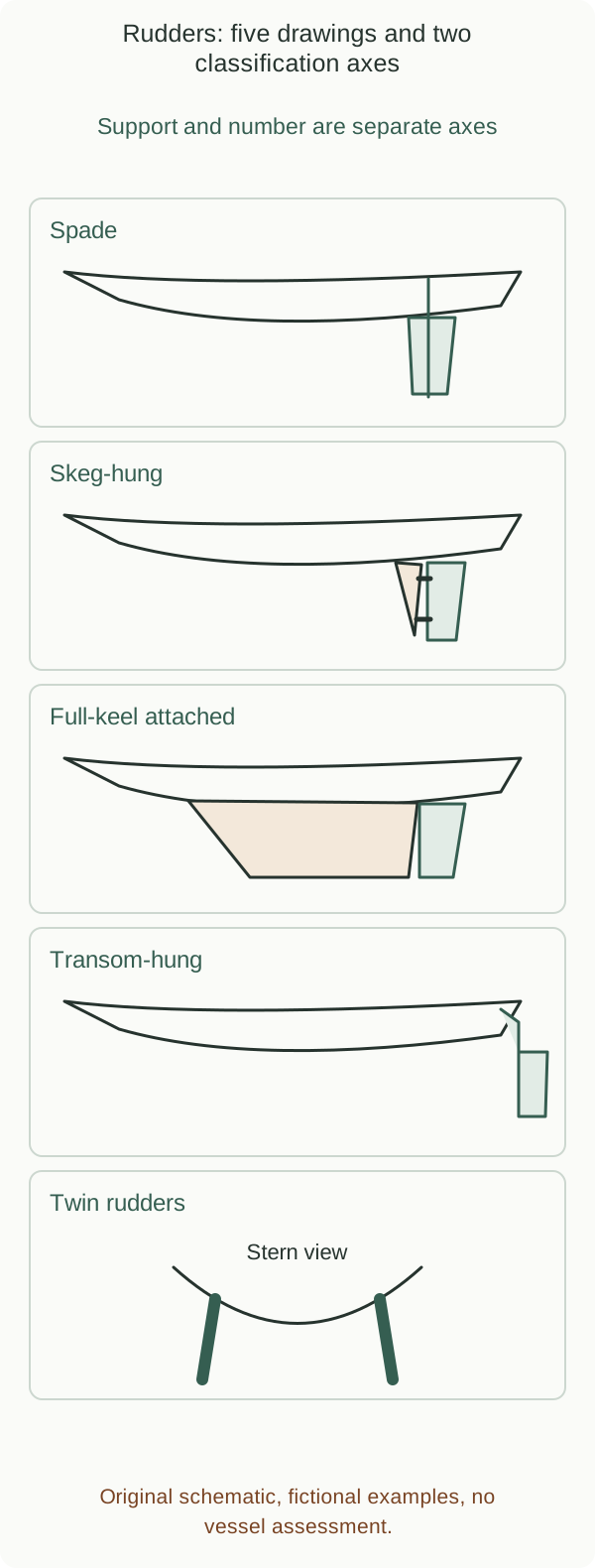
Original schematic, fictional examples, no vessel assessment.
insideSailOriginal insideSail artwork — all rights reservedEnlarge the diagram
Recognise support arrangements
| Label | What to look for |
|---|---|
| Spade | Blade without a supporting skeg ahead; supported through its stock. |
| Skeg-hung | A fixed element ahead carrying support or a rudder hinge. |
| Full-keel attached | Rudder hinged near the aft end of a long keel. |
| Transom-hung | External rudder hinged to the transom. |
| Twin rudders | Two, usually lateral, rudders; each support needs its own classification. |
An element ahead of part of the blade may be a partial skeg. Its presence does not mean the whole blade is supported over its height.
A transom-mounted rudder can also resemble a free-standing blade. A side photograph therefore need not settle every label.
Inspect stock, supports and construction information where available. Commercial terminology may abbreviate an arrangement needing fuller description.
Record a partial support explicitly rather than assuming the most complete arrangement from a familiar word.
From architecture to water flow
Hydrodynamic force requires relative water movement. A single rudder close to propeller discharge and two lateral rudders outside that discharge need not receive equivalent flow at low boat speed.
A familiar manoeuvre can consequently produce a different response on another boat. This lesson supplies no berthing recipe: propeller position and rotation, hull, wind and current still matter.
Visible geometry provides a clue rather than a complete prediction. The condition of linkage, bearings and control equipment is another independent layer.
Maintenance questions are specific
A visit can establish access to supports, steering connections and inspection points. Photographs of the theoretical model do not establish their condition in a forty-year-old specimen.
External mounting can make parts visible, but visibility does not certify integrity. Twin rudders add components without establishing a fixed maintenance cost.
Keep observation, construction documentation and intervention history distinct. Each has a useful role and its own limits.
A photograph captioned “new rudder” should not automatically become a verified original-model specification.
Builders document different arrangements and may argue for their chosen architecture. A commercial claim about protection or control should not become a safety rule for an entire family.
The comparator presents configuration and practical questions without declaring a structural winner. If support is unverified, that is the honest result.
Distinguishing the axes helps locate relevant information and prevents one word replacing an explanation. A model option and a later owner modification should also remain distinguishable.
Sources and references
- RM Yachts — keel configurations ↗
RM Yachts · Range opening; RM890+ versions; RM980 twin rudders.
Manufacturer directly consulted for documented configuration examples only. Marketing assurances are not adopted.
Checked on - Frequently asked questions — rudder architecture ↗
Hallberg-Rassy · Twin-rudder versus single skeg-hung discussion.
Manufacturer configuration account directly consulted; its blanket safety comparison is not endorsed.
Checked on - Rudders, skegs and spades — Ted Brewer ↗
Ted Brewer / Good Old Boat · Original Issue 26, September/October 2002; attached, skeg and spade terminology.
Creator account read for support taxonomy only. Stall angles and blanket structural/safety comparisons not adopted.
Checked on
Keep discovering
The next piece of the puzzle
Discuss this concept
Loading the conversation…