By insideSail
Published without technical review · version 2 ·
Sloop, cutter, ketch and yawl: read the rig
Count masts and locate the mizzen without confusing rig with installed sails.
In this guide
Rig describes the organisation of masts and sails; inventory describes the actual sails aboard. A sloop can carry several stored sails and remain a sloop.
A photograph with only the mainsail set does not establish a single-sail rig either. Begin with mast number and position, then supports and headsail arrangement.
This avoids classifying a boat from an incomplete moment. The diagram depicts four simplified families, with deliberately fictional proportions and no actual model sail plan.
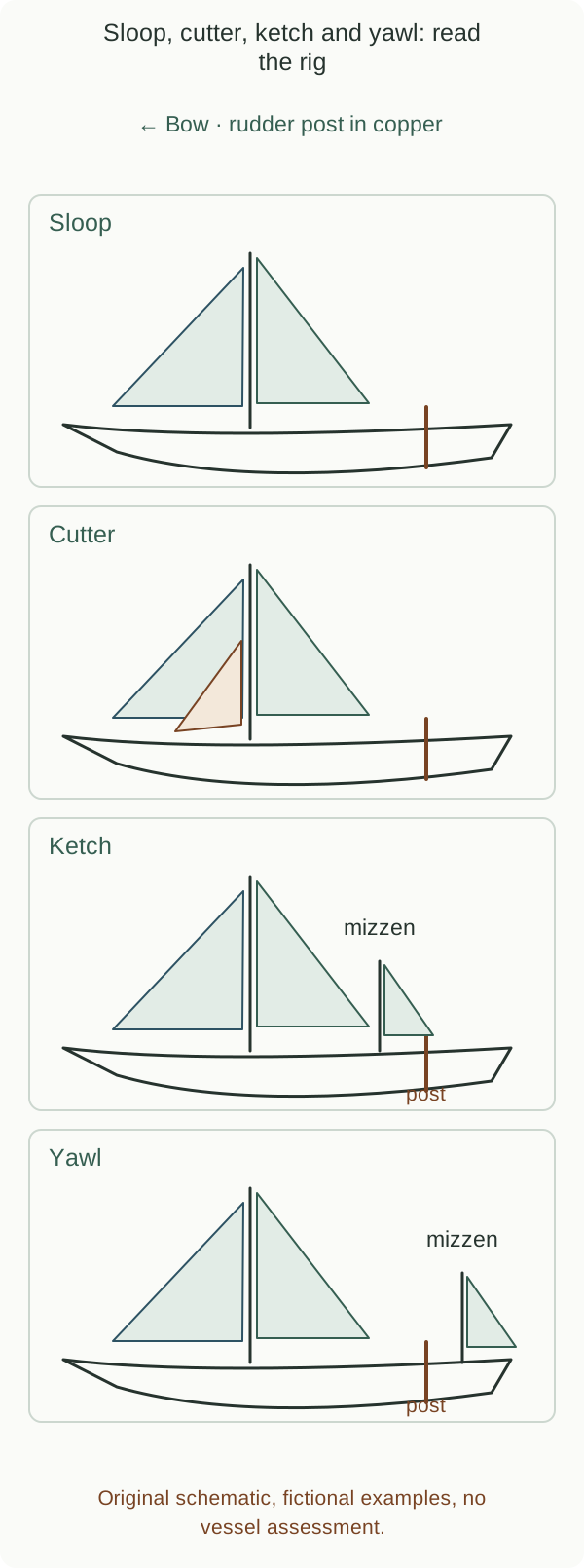
Original schematic, fictional examples, no vessel assessment.
insideSailOriginal insideSail artwork — all rights reservedEnlarge the diagram
One mast: sloop and cutter
The usual sloop arrangement combines a main and one headsail. That headsail may be a jib or genoa, with forestay heights varying between installations.
Cutter commonly denotes one mast with two headsails designed into the arrangement, including an inner staysail. Historical and modern terminology is not identical.
Two furlers alone do not establish cutter status: a Solent arrangement may carry alternative sails rather than two intended to work together. Prefer builder documentation over a photograph-based guess.
Masthead and fractional describe forestay attachment height relative to the mast; they are not synonyms for sloop and cutter. Store this second axis without replacing the first.
Apparent height in a photograph also depends on perspective. Unknown arrangements do not justify an imagined fraction.
A catalogue should assemble sourced, compatible descriptions rather than force every label into a field. Mast number, forestay geometry and inventory each answer a separate question.
Two masts: the detail distinguishing ketch and yawl
In these depicted arrangements the mainmast is forward and the mizzen is the smaller aft mast. The classical distinction places a ketch’s mizzen forward of the rudder post and a yawl’s aft of it.
The drawing marks the rudder axis as the reference. Do not substitute the wheel: it can be elsewhere and work through linkage.
Nor is a small mizzen sail alone diagnostic, because size does not establish that positional relationship. Aft cabin and cockpit labels belong to other design axes.
What changes in use?
Spreading area among more sails creates options and more components to manage. It does not establish that every sail will be light or that two people will automatically find the boat easy.
Areas, controls, access, condition and intended use matter. One mast likewise does not guarantee simplicity in every manoeuvre.
Compare the actual system with the intended crew. Family recognition is a starting point; practical selection also involves reefing arrangements and the sail inventory actually available.
Sources and references
- Sea Scout Manual — rig identification ↗
Scouting Ireland · 11th edition ©2002, 2011 printing; printed pp.128–130 / PDF pp.129–131: sloop, cutter, yawl and ketch.
Title/edition and selected pages directly read. Filename 2013 is not asserted as publication date. No source rig drawing, numerical sail proportion or US training requirement reused.
Checked on
Keep discovering
The next piece of the puzzle
Discuss this concept
Loading the conversation…