By insideSail
Automated technical check · version 2 ·
Construction and ageing: read the boat’s layers
Material, structural architecture and condition are different information.
In this guide
“Fibreglass hull” is useful but incomplete. It can identify reinforcement without explaining resin, laminate arrangement or the presence of a core.
“Steel boat” likewise establishes no thicknesses, protection or history. Separating material, construction and condition avoids turning a family name into a judgment about an individual boat.
This chapter explains structural vocabulary and evidence reading rather than remote diagnosis, repair instructions or approval of a vessel.
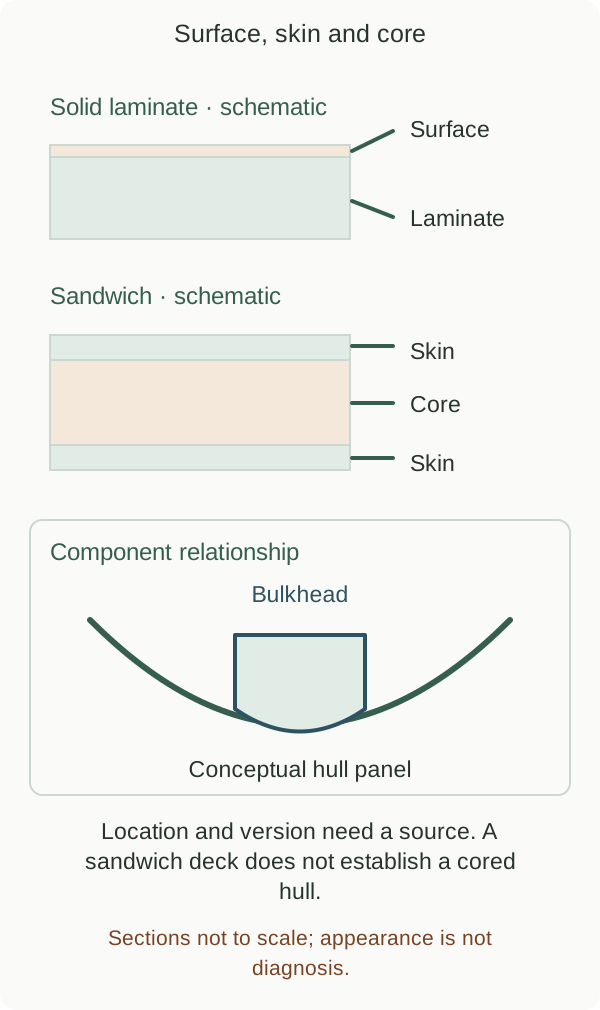
Sections not to scale; appearance is not diagnosis.
insideSailOriginal insideSail artwork — all rights reservedEnlarge the diagram
Reinforcement, matrix and architecture
In a fibre-reinforced composite, reinforcement and matrix work together. Laminate describes an arrangement of layers; gelcoat identifies a surface coating used in certain constructions.
A glossy surface does not automatically reveal structural layering. The drawing separates elements without depicting any particular yard.
The names help read original manufacturer documentation rather than replacing it with an invented editorial specification.
A sandwich panel combines skins and a core. Separation between skins participates in structural architecture; a core is not merely “air inside the hull”.
Materials and processes vary. A boat may combine solid-laminate and cored areas, so a statement about the deck should not be transferred to the entire hull.
Construction needs location, version and source just as keel type or original engine specification does.
Structure is also a relationship between components
Bulkheads, stringers, frames and other components can distribute loads and relate panels. One name may describe different materials in different constructions.
A structural bulkhead should not be confused with a decorative partition merely because it looks similar. A conceptual diagram explains functions and relationships; model documentation and individual assessment establish what actually exists.
Hull, deck and fitting relationships belong to the assembly rather than only its outward appearance.
Age, mechanism and visible sign
Ageing is not one mechanism. Exposure, use, interventions and storage can produce different histories in boats built in the same year.
Metal corrosion, moisture and mechanical damage describe different phenomenon families. A crack or blister is an observation; its cause and significance require assessment.
Manufacturer literature distinguishes possible blister causes, for example. Every irregularity in a photograph should not be labelled osmosis.
Reading reports usefully
A report has a date, an object and a scope. Access, methods and observation conditions may be limited.
A finding about one area does not automatically describe another area that was not observed. “Inaccessible”, “recommendation” and “confirmed” have different roles.
When comparing used boats, retain those distinctions instead of reducing the document to “passed survey”. An older assessment also cannot predict subsequent changes to the individual boat.
On the platform, a model page retains documented construction facts. An owner can report observations and interventions on their boat, labelled accordingly.
Editorial analysis can explain access or complexity implications using public criteria. These are three useful layers that do not replace one another.
Measurement, repair or structural acceptance requires specific content, known conditions and competent review rather than selection of a material filter.
- Material does not describe all construction; age does not describe all condition.
- Location and source accompany claims about laminate or core.
- Observation, diagnosis, intervention and acceptance have different scopes.
Sources and references
- Fiberglass Boat Repair & Maintenance — edition information ↗
WEST SYSTEM · Opening paragraphs: third edition, revised January 2021, 156 pages.
Bibliographic support for the edition, not a claim that a repair has been reviewed.
Checked on - Blistering or Bubbling ↗
International / AkzoNobel · How to recognise it; Cause 9 and Cause 10; recommendation for expert assessment.
Official indexed page text consulted; subsequent direct fetch unavailable. Used only to distinguish possible causes and appearance from diagnosis. Treatment, dimensions, chemical recipes and application instructions excluded.
Checked on - Fiberglass Boat Repair & Maintenance — 002-550 ↗
Gougeon Brothers / WEST SYSTEM · Section 1.1, fiberglass construction; 1.1.5 hydrolysis; construction terminology and cored panels.
Official 156-page PDF directly consulted. Filename year is not treated as edition date: official landing page identifies third edition, revised January 2021. Only structural vocabulary and distinction of damage mechanisms used; no repair instructions or protected drawings.
Checked on
Keep discovering
The next piece of the puzzle
Discuss this concept
Loading the conversation…