By insideSail
Automated technical check · version 2 ·
Boat care starts with a history you can follow
Separate identity, observation, completed work and checking.
In this guide
A model has a production history; an individual boat has a history of use and changes. These are different scales.
Two boats of one model can have different engines, lines or equipment, and their records can differ in depth. A useful care history connects events to specific components.
“Everything checked” sounds reassuring but provides less traceable information than a clear description of what was observed, done and documented.
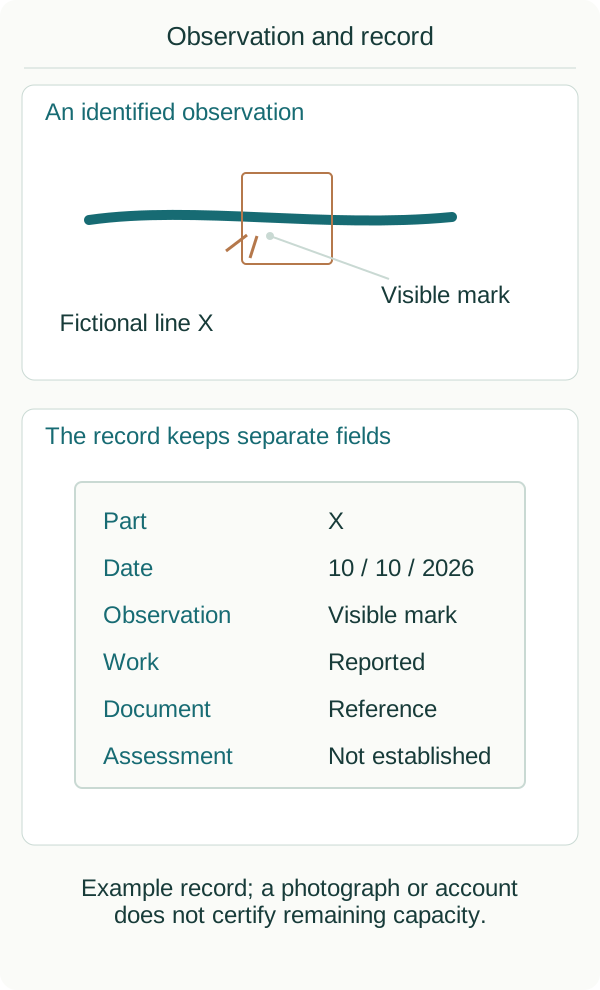
Fictional observation and reported-work record; not a technical opinion.
insideSailOriginal insideSail artwork — all rights reservedEnlarge the diagram
Four layers of an event
Identity explains which component or system is involved. Observation describes what was seen or measured.
Intervention describes work carried out. Checking describes what was confirmed and by whom, within a stated scope.
These layers can be related without being equivalent. A photograph of a new component records presence at an instant; an invoice records declared work; an acceptance conclusion needs its own evidence.
Dates also have different roles. A photograph’s date, a job’s date and a record-entry date need not coincide.
A record written today about earlier work should retain that distinction. Likewise, the boat’s build date is not the installation date of every component.
A chronology becomes understandable when it distinguishes event from documentation rather than turning all fields into a vague notion of recentness.
A fictional history in three entries
Record status and equipment condition
A record can be incomplete while equipment functions; it can be well documented without implying an absence of wear. Information quality and physical condition are independent dimensions.
This avoids turning an organised history into certification. Language can remain concrete: identity confirmed by a document; work declared in a reference; owner observation awaiting clarification.
Each expression keeps the claim proportional to the supporting evidence.
It is also useful to retain the configuration addressed by a document. A family manual does not necessarily identify the installed version.
A rope with a new termination still needs product identity and the work context. An engine change belongs to the individual boat receiving it; it does not alter the original engine specification for every boat of that model.
The history connects information while retaining its distinct origins.
Records that support a conversation
In a professional conversation, a localised question is clearer than “the boat needs maintenance”. Identifying system, event and document makes it possible to discuss the same object.
When sharing experience with other owners, naming the configuration and separating observation from conclusion makes the account more useful. It remains an individual boat’s experience even when others recognise a similar theme aboard theirs.
A good history preserves what was known at each stage and adds findings without erasing the sequence. This explains changes, connects documents and gives the next question context.
It is an information-organisation method rather than a maintenance plan. Care intervals, products, tests and acceptance criteria should come from specific documents and people competent to assess the actual system.
Takeaways
- Identity, observation, intervention and checking are separate layers.
- Event date and record-entry date can differ.
- A traceable history supports decisions; it does not certify condition.
Sources and references
- Hints and Advice on Rigging and Tuning ↗
Seldén Mast · Printed pp.12–14 Running rigging; p.56 Booms.
Selected official PDF sections consulted on 10 October 2026. Component/control identity only; no tuning, loading or reefing instructions. Edition year not inferred.
Checked on - Rope care advice ↗
Marlow Ropes · Terminations; Inspection; identification of condition-dependent care.
Only documentation/termination distinctions used. Cleaning, temperatures, inspection instructions, strength factors and retirement rules excluded.
Checked on
Keep discovering
The next piece of the puzzle
Discuss this concept
Loading the conversation…