By insideSail
Published without technical review · version 2 ·
Reducing sail: three mechanisms, area and shape
Slab reefing and furling are different mechanisms, and reduced area does not explain everything.
In this guide
Reducing sail means decreasing effectively exposed sail area. Depending on the installation, that may involve slab reefing, furling or changing sails.
The aim is more than a smaller number: resulting shape, control loads and the overall arrangement also matter. This lesson explains mechanisms rather than giving a universal boat procedure or one wind strength at which every crew must act.
The drawings deliberately leave installation-specific control routing to the relevant equipment documentation.
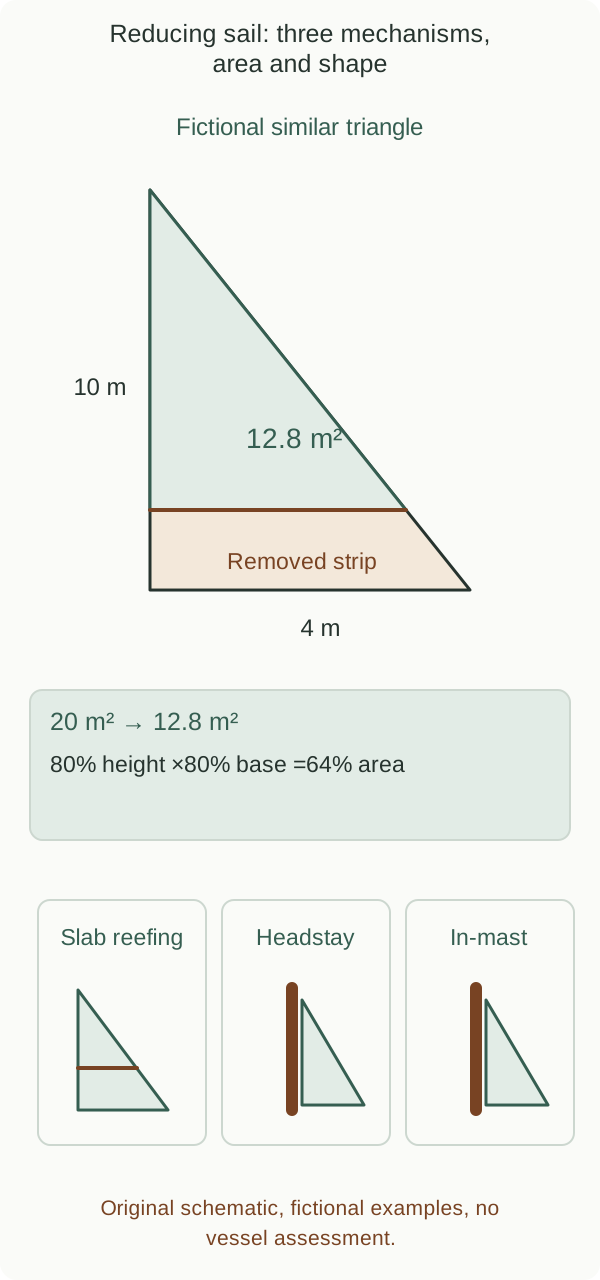
Original schematic, fictional examples, no vessel assessment.
insideSailOriginal insideSail artwork — all rights reservedEnlarge the diagram
Slab reefing a conventional main
In the diagram, a new tack and clew define the sail’s working base; cloth below it is outside the active area. Support and tension at the new points depend on installation.
Small cloth-gathering points should not be confused with the main points carrying the reefed arrangement. No line circuit is drawn for use as a fitting template.
Boom documentation, sail design and practical instruction aboard determine the correct procedure. Recognising changed geometry is distinct from knowing how a particular system is operated.
Furling at the headstay or mast
A headstay furler gathers part of the headsail around its system. An in-mast mainsail gathers into the mast arrangement.
In-boom systems also exist, with their own documentation. “Furler” does not establish that every installation is designed to work partly furled in all conditions.
Distinguish storing a sail completely from operating a reduced arrangement. Product identity and applicable instructions establish that distinction.
A photograph showing some cloth rolled away does not validate its load-bearing use.
Area and shape can change together
Area need not change linearly with the length gathered. Furling also alters exposed geometry and may change depth and cloth distribution.
The simplified example uses a flat triangle; a real sail has an outline and three-dimensional shape. Neither area nor behaviour follows merely from a turn count.
A particular Seldén Furlex manual distinguishes reefed and unreefed sail shape, but its instructions cannot automatically be transferred to another product. Installation-specific explanations belong with the actual system.
The relationship in numbers
Fictional triangle: A = height × base / 2
Lengths in m; area in m².
Store documented system type as a catalogue fact. Editorial assessment can describe access and controls using explicit criteria.
An owner boat records equipment actually installed and known history. Avoid inferring safer or easier from the label alone.
Sail reduction is a practical competence involving conditions and anticipation. The diagram explains what changes so that the next question to an instructor is better informed; it does not replace that instruction.
A reduced configuration also remains distinct from a verified storm-sail installation.
Sources and references
- Furlex 400 S and 500 S — assembly and operation ↗
Seldén Mast · 595-116-E, 15 January 2015; section 12, printed p.38, reefed versus unreefed sail shape.
Official PDF selected section directly read. Mechanism distinction only; operating sequence is not generalised to other systems.
Checked on - Furling mast Type RB/RC ↗
Seldén Mast · 595-020-E, 3 October 2007; product description p.2.
Official product description directly read; no tuning, maintenance interval or reefing procedure transferred.
Checked on
Keep discovering
The next piece of the puzzle
Discuss this concept
Loading the conversation…