By insideSail
Published without technical review · version 2 ·
Two cabins or three? Map a family’s life aboard
Separate berths, compartments, circulation and storage instead of counting doors alone.
In this guide
A family of three needs sleeping space but also somewhere to store clothes, eat, read and move while someone is already asleep. Cabin and berth counts answer only part of that need.
Cabin denotes a compartment, berth a sleeping place. A convertible saloon may increase advertised berths without adding a cabin.
This lesson uses fictional layouts and an access network rather than a dimensioned plan of an actual model. Comfort claims remain questions until the relevant evidence is known.
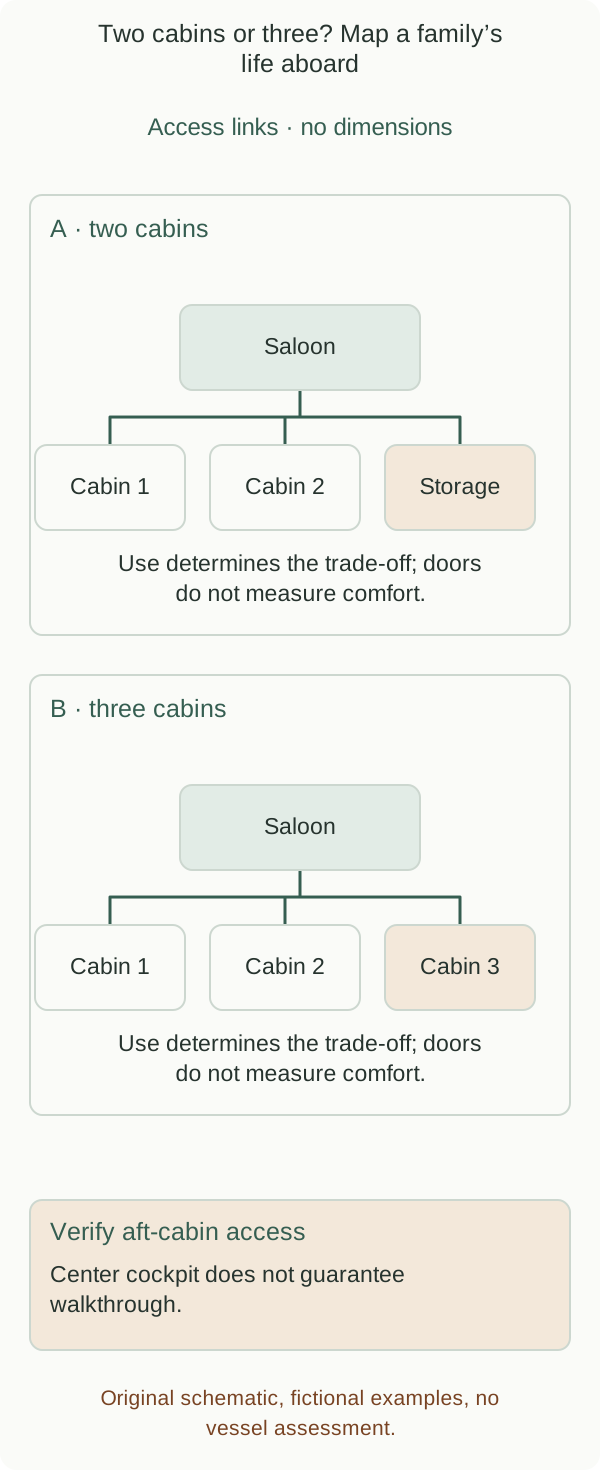
Original schematic, fictional examples, no vessel assessment.
insideSailOriginal insideSail artwork — all rights reservedEnlarge the diagram
Compare specific needs
Owner’s version and charter version are variant labels rather than universal cabin-count categories. Record the documented layout.
A central or island berth may provide access on its sides, while a V-berth follows bow geometry. Transverse berths and quarter berths describe other arrangements.
Bed shape does not establish usable width, space overhead, access difficulty or noise. Measurements and observation complement the label; do not infer dimensions from a photograph.
The same nominal layout may also have changed during production.
An aft cabin needs an access description
An aft cabin is aft, but its route may remain inside or require going out through the cockpit. Center cockpit alone does not guarantee a walkthrough.
A useful documented example is Hallberg-Rassy’s distinction between the 352’s normal internal access and a rare hardtop option with cockpit-only aft-cabin access. That is a configuration difference rather than a comfort opinion.
Marking every specimen of the model with one access arrangement loses that distinction. Keep a layout fact attached to its applicable version.
Galley, heads and circulation form a system
U-shaped, linear, up and down galleys describe shape or level relationship. They do not establish cooking support at sea, ventilation or appliance access.
A separate shower occupies a distinct space from the heads area; a curtain photograph alone does not establish a separate compartment. Obtain the plan and check routes: does reaching the heads cross a cabin?
Does opening storage obstruct passage? Is a sleeping space beside an area used at night?
These use questions have observable answers.
Headroom needs a location: saloon maximum does not describe an aft passage. A cabin may have substantial sleeping area and little space for dressing.
Useful storage depends on access, moisture, shape and intended use rather than stated volume alone. Our diagram shows compartments and connections without measuring these properties.
A visit or documentation can complete the analysis while keeping impressions separate from technical facts. Claims about privacy should distinguish circulation from acoustic separation, which the network cannot establish.
In the Finder, two required cabins differs from a preference for internal access or a free saloon. Reasons and data gaps should remain visible.
The model offers documented layouts; an individual boat may have alterations. Community experience, clearly labelled, can reveal useful questions.
Editorial comparison can explain the trade-offs of A and B without declaring a universal winner or assigning habitability scores without public criteria. More doors can meet one priority while consuming space needed for another.
Sources and references
- Hallberg-Rassy 352 — historical technical documentation ↗
Hallberg-Rassy · Continuous improvements and Rare hardtop option sections; aft-cabin access variation.
Manufacturer text directly read. Only the documented distinction between normal internal access and the rare cockpit-only hardtop arrangement is summarised. No source layout traced or marketing judgement adopted.
Checked on
Keep discovering
The next piece of the puzzle
Discuss this concept
Loading the conversation…