By insideSail
Automated technical check · version 2 ·
A sailboat map: spaces, parts and systems
Start by locating what you see and understanding what it does.
In this guide
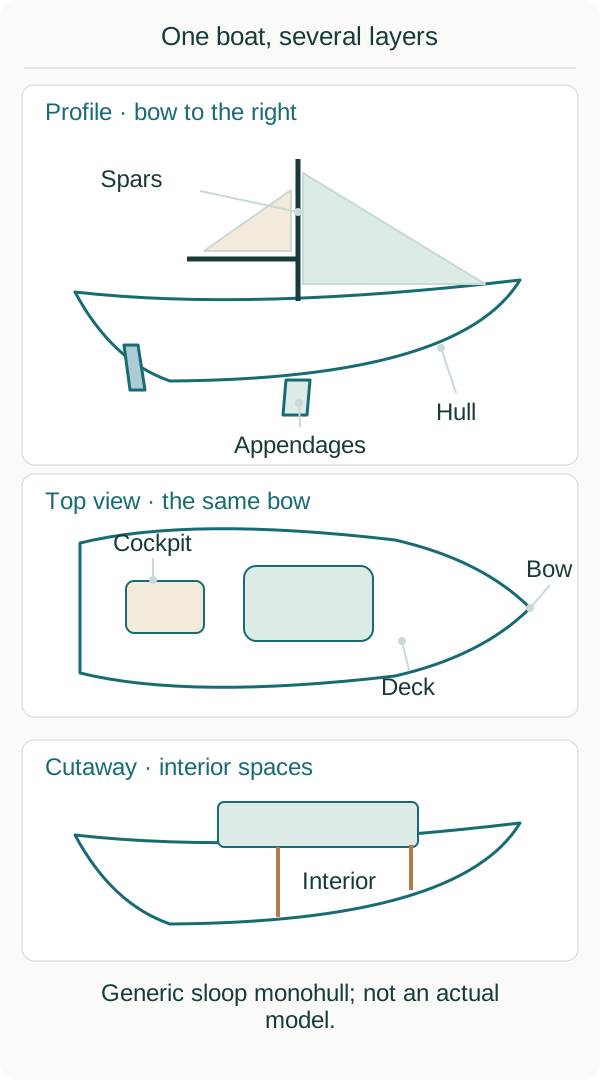
Profile, top view and cutaway of a fictional monohull. The bow is to the right in all three views; not to scale.
insideSailOriginal insideSail artwork — all rights reservedEnlarge the diagram
Read the figure as you would an unfamiliar house: first the whole, then the spaces and only then the parts. On a sailboat, the bow orients your reading.
The hull organises the volume seen from outside; the deck covers and connects upper areas; the rig sits above; some elements lie underwater. This drawing uses a monohull with a simple rig.
A catamaran or two-masted yacht has a different arrangement, but the questions used to read it remain useful.
Finding the groups on the boat
In the diagram, first follow the hull volume between bow and stern. Above it lies the deck, with raised volumes forming the coachroof.
The cockpit is an exterior area for people and may include the steering position. The mast rises above this assembly; in the illustrated rig, the boom extends beside the lower region of the mainsail.
Underwater lie elements with separate jobs, explored in the appendage chapter. Now move to the interior plan: the saloon is the social area, the galley the area for preparing meals and cabins organise compartments.
The companionway relates this view to the exterior. This route offers two complementary ways to divide the same boat: by location and by function.
One element can participate in both. A bulkhead separates spaces and may have a structural role, while a mast belongs to the rig but also needs support within the boat’s assembly.
The figure makes those relationships visible before we develop each name.
A place, a part and a function
Cockpit names a space. A wheel is a part that may be in that space.
Steering is the function of the system to which the wheel belongs. These are not three names for the same thing.
The distinction helps below deck too: galley describes an area of use; a door is a component; a passage describes a connection between spaces. Starting with these categories reduces the feeling that every word requires a complete technical definition before you can continue.
| Question | Example answer | What is still missing |
|---|---|---|
| Where is it? | The wheel appears in the cockpit. | Where the other steering components sit. |
| What does it do? | The sheet is associated with controlling a sail. | The actual system and path. |
| What kind of information is this? | The photograph shows an opening. | Its dimensions, documentation and use. |
Different views answer different questions
A profile helps relate length, mast and appendages. A plan shows positions and connections from above.
A section reveals heights and volumes hidden in the plan. None of these views contains everything.
A berth can look wide on a plan without telling us the clearance above it; a passage can appear without revealing its usable space. Good reading combines views instead of trying to extract every answer from the most attractive image.
Worked example: a holiday photograph
To continue investigating, match each question to an appropriate document. A layout can explain cabins and doors; a specification can state material and dimensions; photographs of the individual boat can show alterations.
If you find a plan of one version and a photograph of another, retain the difference. Combining their features into one description would create a boat that may never have existed.
This is where a map of parts meets a map of information.
A part can contribute to several systems
The figure’s groups help organise a reading; they are not walls between disciplines. A mast relates both to the rig and to the structure supporting it; a bulkhead can separate compartments and contribute to structure; an opening connects outside and inside.
The part’s name is only a beginning. Next ask how it relates to the rest of the boat.
This approach avoids learning a collection of disconnected objects and makes later explanations easier to follow.
Three things to remember
- Locate the bow and identify the drawing’s viewpoint first.
- Separate space, part and function before interpreting features.
- A picture shows part of a boat; documents and configurations complete the reading.
Sources and references
- Hallberg-Rassy 352 — standard specification from December 1987 ↗
Hallberg-Rassy · p.1 Hull / Deck and superstructure / Spars and rigging / Deck fittings; p.3 Accommodation / Steering; p.4 specification/options notice.
Four-page historical specification. The document states From December 1987; publication day is unknown. Not a specification for every surviving individual boat.
Checked on - Nomenclatura de uma Embarcação ↗
CMAS Europe · Lists: proa, popa, amura, alheta, través; vante, ré, meia nau; obras vivas/mortas.
Portuguese terminology consulted; photographs and navigation-light references are not reproduced.
Checked on
Keep discovering
The next piece of the puzzle
Discuss this concept
Loading the conversation…