
By insideSail
Automated technical check · version 3 ·
Bow, stern and sides that stay put
A simple map for finding your way around a boat, even when you turn around.
In this guide
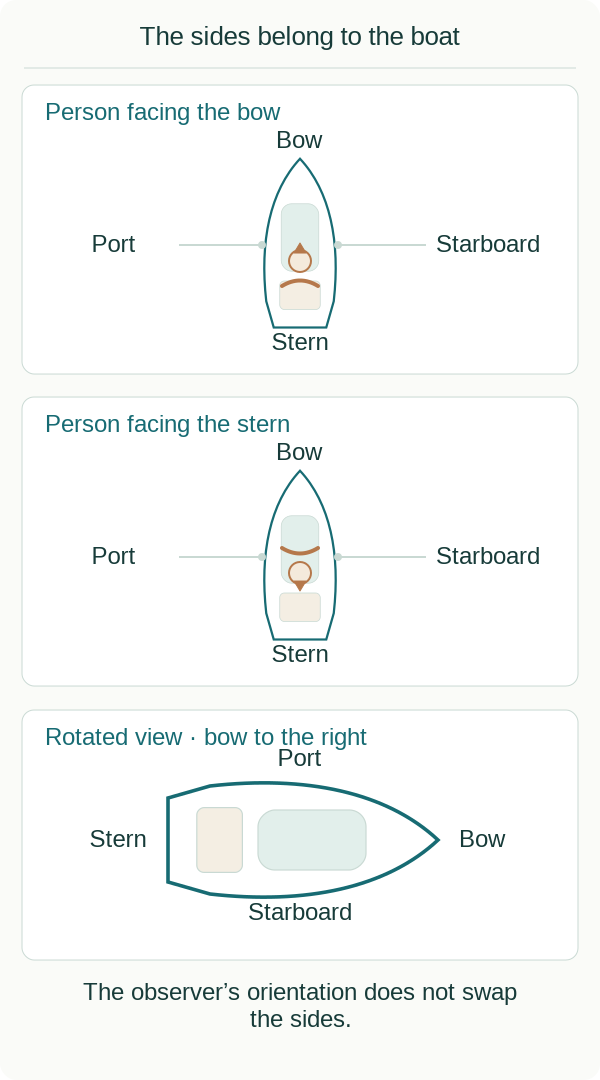
Schematic top views. Changing the person’s or drawing’s orientation does not change the boat’s sides.
insideSailOriginal insideSail artwork — all rights reservedEnlarge the diagram
Bow and stern orient the boat; port and starboard identify its sides. Facing the bow, port is left and starboard is right.
The reference belongs to the boat. Turning around, entering a cabin or watching from another quay does not change the names.
This simple idea makes descriptions of spaces and parts clearer, especially when several people stand in different positions.
A caption that survives a change of viewpoint
Compare three captions for one fictional locker: “locker on the left”, “locker seen from the entrance” and “locker to port in the saloon”. The first depends on a person; the second adds the observation point; the third relates the object to boat and compartment.
Each may be useful for a purpose, but only the last retains its location when the plan rotates. Everyday conversation need not become formal.
Where location matters, add the missing reference. In a drawing without a marked bow, first look for the orientation stated in its key or in another matching view.
A pointed shape may suggest the forward end, but a cropped interior picture may not reveal it. A catalogue picture of another configuration does not establish the locker on this individual boat either.
Orientation resolves the side; identifying the object and craft resolves the rest. This makes a caption useful beyond the exact position in which its author first saw the object.
Two people, the same side
Imagine two people facing each other in the cockpit. One looks towards the bow; the other towards the stern.
Their left hands point to different sides. If both identify port, they point to the same side of the craft.
“The part is on my left” describes one person’s viewpoint, while “the part is to port” gives a reference another person can reconstruct. You need not physically face the bow: you need to know where it is.
| Term | Reference on the boat |
|---|---|
| Bow | Forward end. |
| Stern | After end. |
| Port | Left when the reference is facing the bow. |
| Starboard | Right when the reference is facing the bow. |
| Forward | Towards the bow. |
| Aft | Towards the stern. |
Worked example: a rotated plan
Now read a door on that same side. A person leaving the cabin may see it to their left; someone entering may see it to their right.
Its location on the boat stays fixed. A more useful description adds the space: “cabin door, to port”, for example.
Precise location does not require a long sentence, just a shared reference. This habit helps when moving from a plan to a photograph taken by an observer facing another way.
Looking from outside does not create new sides
If you look at a boat head-on, the left of your image corresponds to the boat’s right side. Locate the bow, reconstruct the reference facing it and identify the sides.
A detail photograph may not provide enough information. “Not identifiable in this image” is then better than a guess.
A photograph may also be mirrored: reversing the image changes its appearance and requires context to avoid a wrong caption.
Side, area and direction are different questions
Port identifies a side; bow and quarter expressions add forward and aft areas. “Off the starboard bow” can describe an object’s position relative to the boat.
A direction such as north uses another reference. A yacht can face north or south and retain the same port side.
Relative-sector and bearing lessons develop these relationships without changing side definitions. Do not automatically connect this vocabulary map to lights, priority or encounter manoeuvres.
Three things to remember
- The fixed reference is the boat, with its bow identified.
- Rotating a picture does not change port and starboard.
- If context is missing, state uncertainty rather than guessing.
Concepts in this lesson
Bow
The forward end of a vessel.
Port side
The vessel’s left side when looking towards its bow. The reference belongs to the boat.
Starboard
The vessel’s right side when looking towards its bow. The reference belongs to the boat.
Stern
The after end of a vessel.
Sources and references
- Port and starboard — fixed references ↗
NOAA National Ocean Service · Fixed sides when facing the bow
Version: Institutional page. Jurisdiction: International.
Checked on - NOAA field manual — nautical terminology ↗
NOAA · Historical field manual; terminology only · Table 15: bow, stern, port and starboard
Version: Historical field manual; terminology only. Jurisdiction: International.
Checked on - Nomenclatura de uma Embarcação ↗
CMAS Europe · Lists: proa, popa, amura, alheta, través; vante, ré, meia nau; obras vivas/mortas.
Portuguese terminology consulted; photographs and navigation-light references are not reproduced.
Checked on
Keep discovering
Loading discussion…