By insideSail
Automated technical check · version 2 ·
Where is it relative to the boat?
Bow, beam and quarter expressions add an area to the side being described.
In this guide
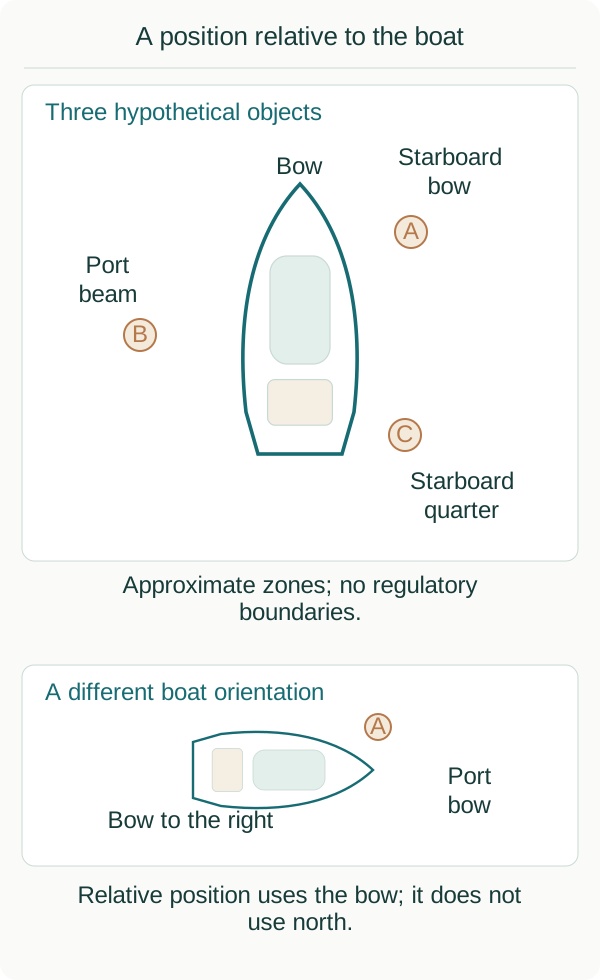
Fictional examples of approximate relative positions; not light sectors or COLREG boundaries.
insideSailOriginal insideSail artwork — all rights reservedEnlarge the diagram
Saying that something is to port identifies a side but leaves a large area to describe. Bow expressions concern the forward part of each side; the beam is the lateral area between forward and aft; quarter expressions concern the after part.
These terms can identify areas of the boat or an object’s approximate position relative to it. The sentence’s context shows which reading is intended.
A part aboard and an object outside
“An opening in the port bow area” locates a part of the boat. “A circle off the port bow” locates an external object in the figure.
The first relationship follows the craft because the opening belongs to it; the second depends on relative position between boat and circle. Rotating the whole picture preserves both.
Rotating only the boat may change the second without changing the first. This explains why sector language appears in layouts, hull descriptions and accounts of what can be seen from aboard, with different purposes.
A complete caption identifies whether it names a physical region or a relative direction. If the next drawing introduces a north arrow, that arrow adds a map reference; it does not replace the boat’s sides or turn approximate words into an angular measurement.
The same vocabulary can therefore remain useful in several drawings while the relationship described stays explicit.
A reference that follows the bow
In the figure, the boat acts as a small frame rotating with it. The bow defines forward; port and starboard retain their sides.
A fictional object outside the boat can lie off the starboard bow, abeam or on the quarter depending on the craft’s orientation. This makes a description more specific without requiring a coordinate.
It also explains why the bow should be identified for a photographic caption to be read correctly.
| Expression | What it adds |
|---|---|
| Off the starboard bow | Forward area on the starboard side. |
| On the port beam | Approximately sideways, to port. |
| On the starboard quarter | After area on the starboard side. |
| Forward / aft | Towards the bow / towards the stern. |
Worked example: the boat turns, the object stays
This example does not represent a navigation decision. There is no second vessel with a heading or speed to assess.
We are separating two pieces of information: where the object sits on the page and where it lies relative to the bow. That distinction helps with other drawings by preventing a relative direction from becoming confused with a fixed map position.
Both descriptions can be true at once because they use different references.
An approximate region is not an angle
The diagram’s areas are deliberately approximate. “On the quarter” helps orient a reading but does not itself give an exact angle.
If a document states a bearing in degrees, the reference and measurement convention accompany that value. The central azimuth-and-bearing lesson explains this notation.
Light sectors and regulatory boundaries are not used as boundaries for these ordinary descriptions: they belong to a different subject and scope.
Two ambiguities worth recognising
English beam also names a dimension: the boat’s width. “Beam of three metres” concerns width; “on the port beam” concerns a relative position.
Portuguese amura can appear in sail descriptions or expressions about sailing tack as well as naming a boat area. A sound translation comes from the whole sentence.
Replacing each word with one dictionary equivalent can make a description less clear even when the individual terms look familiar.
A useful description can combine side, area and object: “portlight in the port bow area”, for example, where a picture shows it. If only the side is known, retaining “to port” is enough; adding an unseen area would create false precision.
Technical language helps when it makes a reference shared and checkable. It need not become more complicated than the available information permits.
Three things to remember
- Relative sectors follow the boat’s orientation.
- Bow, beam and quarter expressions add an area without always specifying an angle.
- Read the context before translating words with several meanings.
Concepts in this lesson
Abeam — relative position
An approximately sideways relationship to the boat, with port or starboard identified. This is distinct from beam as the boat-width dimension.
Bow area — relative sector
The forward region of each side, also used as an approximate reference for something ahead and to that side of the boat. This is a relative area, not a light-sector boundary.
Quarter area — relative sector
The after region of each side, also used for an approximate position aft and to that side. The boat supplies the reference.
Sources and references
- Nomenclatura de uma Embarcação ↗
CMAS Europe · Lists: proa, popa, amura, alheta, través; vante, ré, meia nau; obras vivas/mortas.
Portuguese terminology consulted; photographs and navigation-light references are not reproduced.
Checked on
Keep discovering
The next piece of the puzzle
Discuss this concept
Loading the conversation…