By insideSail
Automated technical check · version 2 ·
Describing something aboard without a list of jargon
Four worked examples combine orientation, function, dimensions and evidence.
In this guide
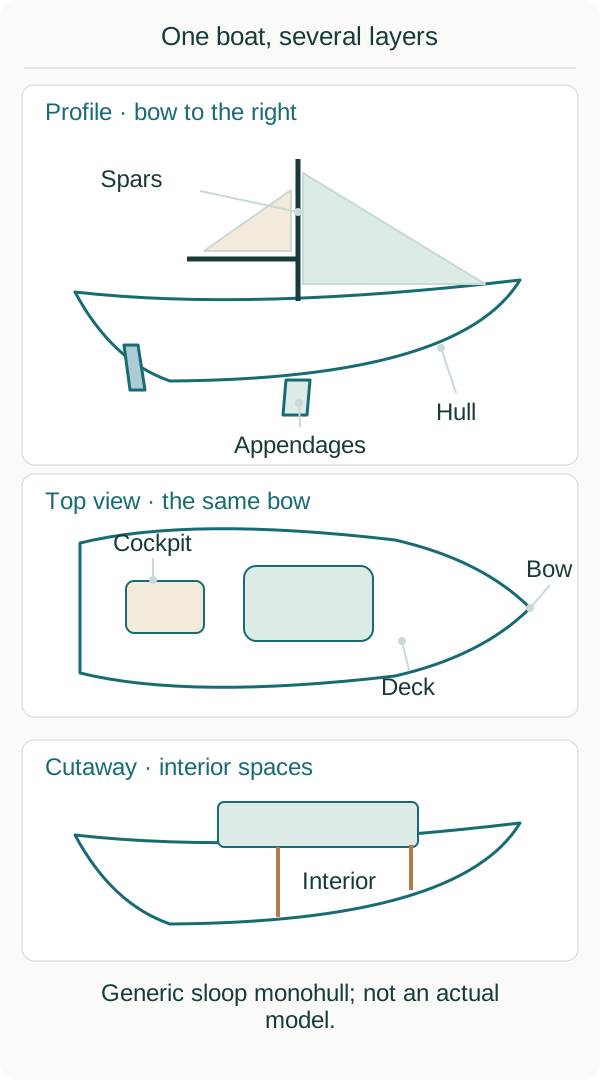
Profile, top view and cutaway of a fictional monohull. The bow is to the right in all three views; not to scale.
insideSailOriginal insideSail artwork — all rights reservedEnlarge the diagram
Terminology is useful when it clarifies a description. You need not add every newly learned word to every sentence.
Choose a shared reference, identify the object and retain the available detail level. The following four examples combine concepts already developed in this manual.
Each explains its reasoning without creating another definition. Figures and situations teach reading rather than issue manoeuvring instructions.
Example 1: a door on the left
The same reasoning applies to an interior photograph. Someone entering and someone leaving may see the door on different sides of their picture.
The boat’s side stays fixed. If the image does not reveal bow or compartment, a careful caption may simply say “door visible in this photograph”.
Clear limited information is preferable to a guessed side. The orientation lesson provides viewpoints completing that reading.
Example 2: beam in a record and a description
Other words deserve the same attention. Sheet identifies a sail-control line in a sail description; knot may be a speed unit or a form tied in rope.
Portuguese amura concerns a boat area and appears in other sail contexts. Concept search helps when it separates senses rather than offers one definition for everything.
Dimensions, sectors and units lessons keep each explanation in its proper home.
Example 3: a new line
If an owner declared a replacement, identify it as concerning that individual boat. The declaration is useful without becoming a model specification.
The conceptual line-path lesson shows functional continuity between components; the materials lesson explains construction and properties. Neither needs to create another identity for a halyard.
Links between lessons add context while preserving its central meaning.
Example 4: an aft cabin in a photograph
This provides the bridge to exploring models. A record may combine objective data, editorial interpretation and owner experience.
Read the information type before joining conclusions. Learned terms help locate features and understand differences, while sources and configurations explain scope.
The result is a description another reader can follow, with missing questions visible and clear routes to deeper learning.
A short caption can retain context
Consider two fictional captions for an opening: “new hatch” and “deck opening on the photographed boat, assembly declared replaced by its owner”. The second is longer, but its essentials fit a short summary: identified part, boat and information origin.
If the equipment name remains unconfirmed, opening retains a valid observation. Adding hatch or portlight depends on the role and documentation already introduced in this manual.
A well-built caption keeps technical detail available without pouring it all into the first sentence. It can present a short name and place context, reference and date beside the image.
This follows the platform’s wider logic: learning a term helps understand information without requiring every sentence to become a complete technical specification. Clarity lies in the relationship between words and evidence, not in the number of nautical words used.
The four examples above can therefore guide both a brief photo caption and a more detailed boat record.
Three things to remember
- A clear reference is worth more than a sentence full of names.
- Context distinguishes words with different senses.
- Describe observation, documentation and accounts without giving them the same status.
Sources and references
- Port and starboard — fixed references ↗
NOAA National Ocean Service · Subtitle and first explanatory paragraph; fixed sides facing the bow.
Page states last updated 23 September 2026. Terminology only.
Checked on - Hints and Advice on Rigging and Tuning ↗
Seldén Mast · Printed pp.6–7 Rig types; pp.8–9 Longitudinal rigging; pp.10–11 Lateral rigging; pp.12–14 Running rigging; p.56 Booms.
Official 92-page PDF retrieved and the stated sections consulted. Edition year not inferred. No tuning procedures or protected figures reproduced.
Checked on - Hallberg-Rassy 352 — standard specification from December 1987 ↗
Hallberg-Rassy · p.1 Hull / Deck and superstructure / Spars and rigging / Deck fittings; p.3 Accommodation / Steering; p.4 specification/options notice.
Four-page historical specification. The document states From December 1987; publication day is unknown. Not a specification for every surviving individual boat.
Checked on - Nomenclatura de uma Embarcação ↗
CMAS Europe · Lists: proa, popa, amura, alheta, través; vante, ré, meia nau; obras vivas/mortas.
Portuguese terminology consulted; photographs and navigation-light references are not reproduced.
Checked on
Keep discovering
The next piece of the puzzle
Discuss this concept
Loading the conversation…