By insideSail
Automated technical check · version 2 ·
Heights aboard: endpoints define the dimension
Mast length, height above water and headroom do not necessarily share an origin.
In this guide
A record may say “mast height” without identifying its endpoints. It could mean spar length, height from deck, a rig dimension or height above a waterline.
Those quantities are not interchangeable. The same issue arises below: headroom concerns space between surfaces rather than hull freeboard.
Ask “from where to where?” before deciding whether two values can be compared or added.
This lesson uses fictional reference lines to read dimensions, not to determine a real boat’s clearance or authorise any passage beneath an obstruction.
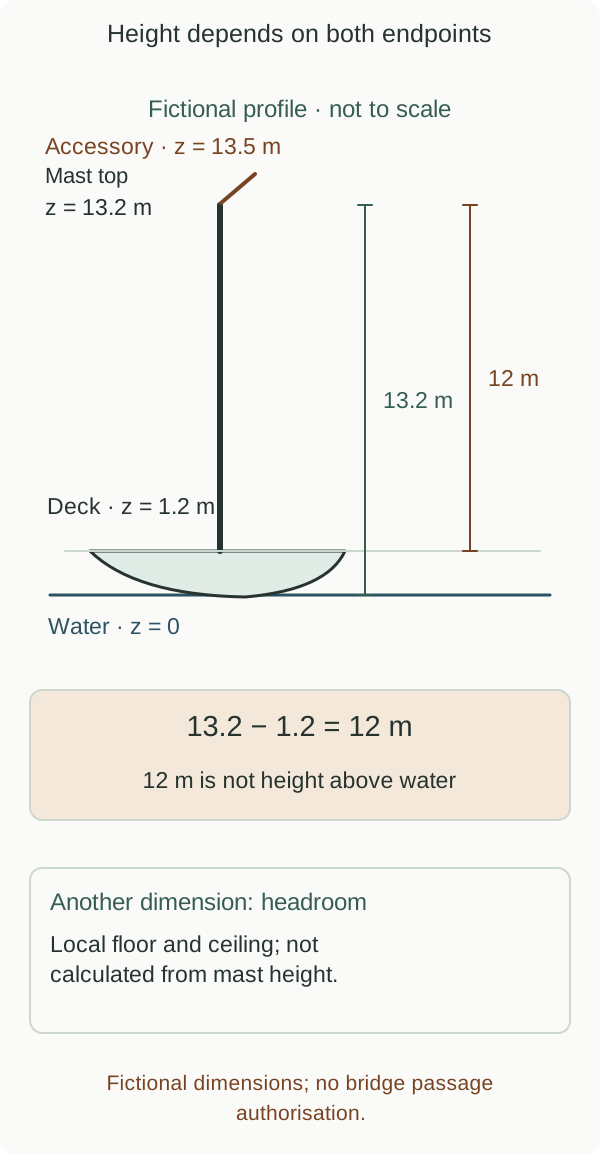
Fictional dimensions; no bridge passage authorisation.
insideSailOriginal insideSail artwork — all rights reservedEnlarge the diagram
Part length and vertical coordinate
A mast can extend below deck. Total spar length includes that portion, while a height above the water does not add it again.
Length along a raked component is also not necessarily its vertical projection. Our ideal drawing keeps the mast upright to make the relationship simple.
A photograph supplies neither that assumption nor a measurement. Preserve quantity type, reference and endpoints when reading documentation, even if the value looks plausible for the boat’s size.
Knowing that two figures have metres as their unit is insufficient to establish that they describe the same interval.
Calculate only with compatible references
Sail dimensions begin at other points
The ORC rig page defines P as a mainsail-luff limiting interval under its convention. Foretriangle height IG has a declared datum, and halyard height ISP has its own definition.
None is a synonym for maximum height above the water. These distinct references answer different measurement questions.
Retain the source definition instead of completing a missing datum because its number resembles another. A sail-plan dimension can be perfectly valid for its purpose and still be unsuitable as the input to a different height question.
Freeboard and headroom belong to different questions
Freeboard relates the water surface to a hull or deck reference at an identified location and condition. Headroom relates the sole to the upper boundary of a relevant interior space.
A coachroof can create local height without providing the same height throughout the saloon. A raised sole can reduce the usable interval while leaving the exterior mast dimension unchanged.
When comparing interiors, ask where headroom was specified, for which configuration and beneath which limiting surface. The largest published figure does not describe every circulation area or prove comfortable movement for every person.
Loading condition and vessel attitude also belong to the reference. If the water surface meets the hull elsewhere, intervals measured from it can change.
We assume no fixed change per tank litre or person: geometry and condition would be required. Catalogue dimensions and those of a loaded individual boat should retain their respective contexts.
Antennas, sensors or brackets can change the highest point without changing model name or spar length. This is a reason to ask for the relevant configuration, rather than subtract a guessed allowance from a published figure and call the result verified.
Distinguish the specification from its application
The official Oceanis 37.1 page presents draught and bridge clearance as separate fields. That demonstrates the importance of quantity names without confirming an accessory-equipped individual boat’s height.
An actual passage introduces water level, obstruction reference, conditions and appropriate nautical information outside this lesson. Documentary comparison can legitimately end with an unanswered question.
Record unit, lower endpoint, upper endpoint, location and condition before accepting a dimension. A number retaining those references is more useful than the apparent precision of adding incompatible fields.
Learning the distinction supports better enquiries rather than supplying a navigation decision.
- Begin with endpoints and measurement condition.
- Do not add an interval already included in another field.
- Local interior height, component length and highest point are different quantities.
Sources and references
- Hints and Advice on Rigging and Tuning ↗
Seldén Mast · Printed/PDF pp.6–10: Rig types, in-line/swept spreaders, longitudinal/lateral terminology; p.4 identification scope.
Official PDF previously downloaded; selected complete pages reread locally on 11 October 2026. Only recognition of architectures, not tuning, stepping, wire sizing, unsupported-span limits or structural acceptance.
Checked on - Rig — measurement references ↗
Offshore Racing Congress · Mast datum point and Foretriangle base; P/IG/ISP and Boom/E: distinct endpoints.
Selected sections read. Dimensional-reference distinction only; no racing measurement procedure, sail area calculation, rating assertion or instrument instructions.
Checked on - Oceanis 37.1 — variants, layouts and specifications ↗
BENETEAU · Specifications: Bridge Clearance and Draft fields, and informational/non-contractual disclaimer.
Official section read. Shows distinct published fields; no model value is transferred to an owner boat, bridge passage or guarantee of highest accessory clearance.
Checked on
Keep discovering
The next piece of the puzzle
Discuss this concept
Loading the conversation…