By insideSail
Automated technical check · version 2 ·
Reading rig architecture in profile and front view
Forestay height, lateral support and mast base are independent questions.
In this guide
The first rig lesson introduces components and functions. Now examine their organisation.
A side photograph may reveal the forestay attachment while concealing shroud geometry. A front view may show spreaders without establishing where the mast rests.
Combining views prevents one visible feature becoming a description of the complete assembly. The purpose is recognition and precise questions rather than assessing or altering rig tension.
Think of the views as complementary evidence: each reveals some relationships and leaves others unresolved, even when the photograph appears exceptionally clear.
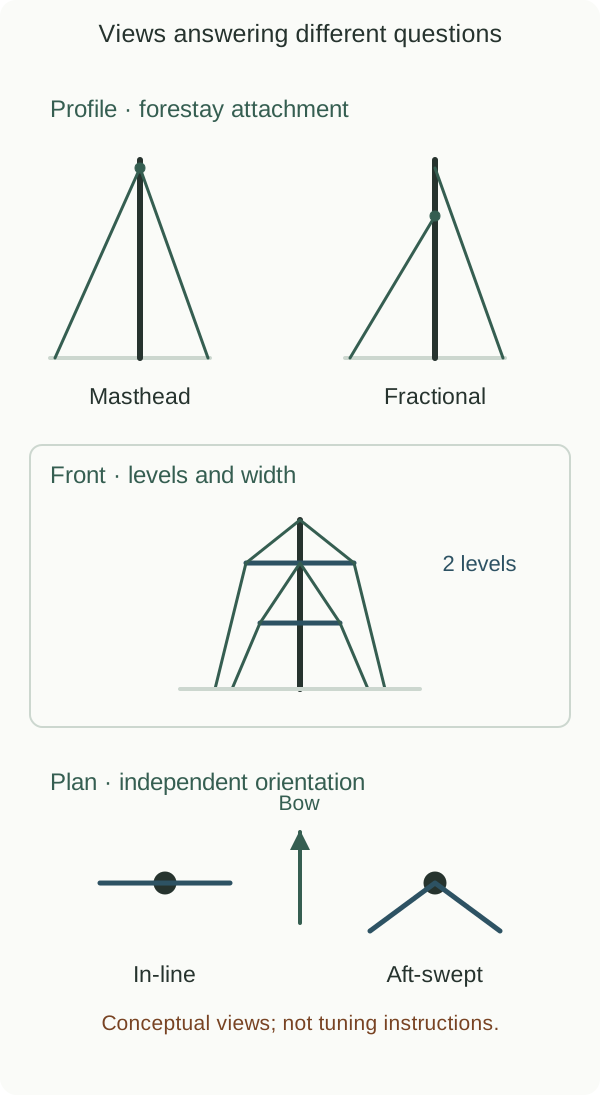
Conceptual views; not tuning instructions.
insideSailOriginal insideSail artwork — all rights reservedEnlarge the diagram
Where does the forestay reach?
In a masthead arrangement, the principal forestay reaches the masthead region; in a fractional one, it meets the mast below. That distinction independently measures neither mainsail area nor the number of inner stays.
The photographed sail head can also depend on which sail is fitted, furling or the observed moment. Follow the depicted stay to its attachment rather than classifying the cloth silhouette.
Assembly documentation confirms identification. A fractional label therefore answers one geometric question; it does not identify all supports or describe the handling characteristics of every rig bearing that label.
Lateral and longitudinal need different views
Spreaders form a geometric relationship with shrouds. A front view reveals levels and lateral separation; a plan view can distinguish transverse alignment from an aft-swept arrangement.
Seldén documentation separates those families from the number of spreader levels. They are not one attribute.
Perspective can make an element appear swept even when its actual plan relationship is unresolved. Identify the view reference instead of estimating an installation angle from an oblique image.
Nor does the visible number of spreaders provide a universal strength ranking: it is part of an architecture whose complete identity is still needed.
Stays and shrouds can contribute to support in more than one direction. Recognising the components does not reveal the complete distribution of forces in the assembly.
Presence or absence of a backstay is another system feature, not proof that a mast is unsupported. Architectures differ.
Identify the documented arrangement and actual components rather than search photographs for a piece presumed mandatory in every design. A missing item in a photograph can mean an obscured item, an incomplete view or a different architecture; these possibilities should remain separate until evidence distinguishes them.
Mast support is separate from forestay height
Deck-stepped and keel-stepped describe mast-base organisation rather than alternatives to masthead and fractional. One support family can combine with one forestay-height family.
In an ideal sketch, one mast ends at deck level; another continues below to its indicated base. Installation detail is omitted, and the drawing assesses no supporting structure.
Distinguishing the attributes helps request the correct information without turning a designation into a strength promise. A roof fitting seen from outside might conceal a different internal arrangement, so its appearance alone cannot settle the base question.
For an actual boat, connect identity, view and source. A replacement mast or changed components may make a historical brochure insufficient.
Saying “it is Seldén” is also incomplete because manufacturers have families and versions. The educational drawing supplies language for reading documents and communicating with someone who knows the assembly.
Inspection, stepping, installation, tuning and acceptance need their appropriate processes. Progress here means separating questions that initially seemed one rig choice, while preserving the fact that an accurate architectural description is not an assessment of the individual system’s condition.
- Forestay position, spreaders and base are separate attributes.
- Use the view revealing each relationship.
- Architectural recognition is not tuning or structural assessment.
Sources and references
- Hints and Advice on Rigging and Tuning ↗
Seldén Mast · Printed/PDF pp.6–10: Rig types, in-line/swept spreaders, longitudinal/lateral terminology; p.4 identification scope.
Official PDF previously downloaded; selected complete pages reread locally on 11 October 2026. Only recognition of architectures, not tuning, stepping, wire sizing, unsupported-span limits or structural acceptance.
Checked on
Keep discovering
The next piece of the puzzle
Discuss this concept
Loading the conversation…