By insideSail
Automated technical check · version 2 ·
Three underwater parts, three different functions
Keel, rudder and propeller may appear together without doing the same job.
In this guide
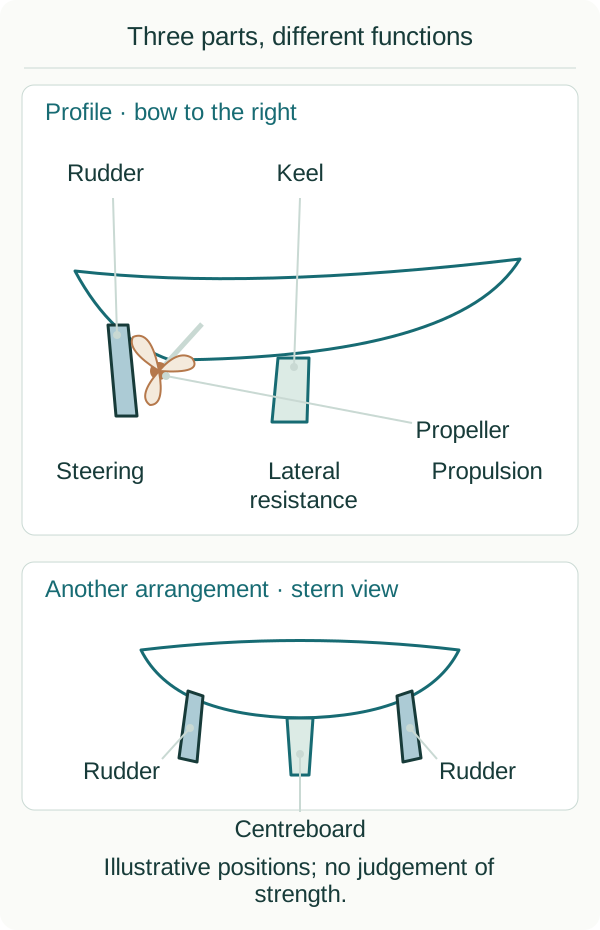
Profile and stern view of fictional arrangements. Functions and locations are not a safety assessment.
insideSailOriginal insideSail artwork — all rights reservedEnlarge the diagram
In a yacht profile, elements beneath the hull appear to belong to one group. Their shared location hides different jobs.
A keel or centreboard contributes to lateral resistance; the rudder belongs to steering; the propeller to propulsion. Some assemblies combine functions or use different arrangements.
The diagram maps these relationships rather than predicting a model’s behaviour.
Shape, mass and movement
The submerged shape of a keel or centreboard contributes resistance to sideways movement through water. Where an arrangement includes ballast, that mass adds a separate role associated with stability.
These are different relationships: a plate used as a centreboard can perform a lateral job without the mass of a ballasted keel. The rudder blade interacts with water moving relative to it.
Changing its orientation changes the flow and resulting force, contributing to a change in the boat’s direction. A propeller works differently: its blades rotate and transfer force to water to generate thrust in the propulsion system.
Recognising a moving surface is therefore insufficient to assign it the same job as its neighbour. In the fictional diagram, follow each element’s relationship upwards: keel to the hull-associated assembly, rudder to steering system and propeller to propulsion transmission.
In the rear view, elements may lie away from the centreline or overlap in a side perspective. Position, number and role complete the physical reading without predicting how a particular configuration behaves.
This is the useful foundation before opening the detailed design-family guides.
Appendage, ballast and lateral function
Appendage describes an element associated with the hull’s exterior assembly. Ballast describes mass positioned with a stability role.
A keel may include ballast, but naming a shape a keel does not reveal its mass or distribution. A movable centreboard is not automatically a ballasted lifting keel.
Separating geometry, function and mass helps read different designs without merging every label.
| Element | Main question | Further information needed |
|---|---|---|
| Keel/centreboard | How is lateral resistance represented? | Configuration, mass where applicable and documentation. |
| Rudder | Which submerged element belongs to steering? | Support, connection and system. |
| Propeller | Which component contributes to propulsion? | Transmission, type and installation. |
A profile does not show everything
A side view may hide a second keel or rudder. A rear view helps recognise positions relative to the boat’s centreline.
Compare viewpoints before counting parts. The figure also omits installation details: its connections are conceptual.
A silhouette helps identify a family; construction drawings and observations of the actual boat address more specific questions.
Worked example: the model name does not choose a keel
In a fictional example, an advertisement mentions two wheels but gives no rudder count. We can conclude that two visible controls exist, not that there are two rudders.
They are different system levels. Likewise, recognising a propeller in a photograph does not establish engine, transmission, fuel use or manoeuvring response.
Each relationship needs its own information rather than gaps filled by visual similarity.
Design families without a universal winner
Canonical keel and rudder lessons compare forms and compromises. Use them after recognising the basic function.
A long keel, fin or bilge arrangement does not summarise stability, behaviour or drying-out capability. The shaft, saildrive and propeller lesson adds propulsion architecture.
Names help organise research without replacing design context, boat condition and intended use.
The chapter becomes clearer with one question at a time. First locate the element, then identify its stated job, and finally check the configuration and document.
If a sentence combines “heavier”, “more stable” and “easier to manoeuvre”, separate those claims and seek evidence for each. An objective feature can be checkable without making every associated inference equally sound.
That distinction keeps model exploration useful for beginners.
Three things to remember
- Different jobs coexist underwater.
- Profile and rear views help distinguish configurations.
- Name, shape, mass and behaviour assessments are separate layers.
Concepts in this lesson
Keel — underwater function
In this lesson’s context, a submerged hull-associated element contributing lateral resistance. An arrangement may include ballast, but shape, mass and job are distinct information.
Propeller
A propulsion element whose blades rotate and transfer force to water to generate thrust. Engine and transmission are other system parts.
Rudder — steering element
A steering element whose blade interacts with water flow; its orientation changes the resulting force contributing to a change of direction. Blade, support and control are distinct aspects.
Sources and references
- RM Yachts — keel configurations ↗
RM Yachts · Range introduction and RM890+ section: fin, twin and lifting configurations.
Configuration example, not a comparative performance or safety verdict.
Checked on - Centreboard Yacht ↗
Alubat · Centreboards; Lifting keels; design-dependent grounding context.
Names and distinctions only. No drying-out or grounding procedure is imported.
Checked on - Boat Crew Handbook — Seamanship Fundamentals BCH 16114.4 ↗
United States Coast Guard · A.9 p.6-8 Propulsion and Steering; A.11 p.6-10 Propeller Action; opening explanation of A.12 p.6-12 Rudder Action.
December 2017 edition with header dated 13 December 2017. Only introductory energy/thrust and water-flow/force principles; no manoeuvre, operating procedure, cavitation explanation or US requirements imported.
Checked on - Rudder — general physical function ↗
Wärtsilä · Opening paragraph: water-flow interaction, transverse force and steering moment.
Only the introductory physical principle is used. Merchant-ship arrangements, operating angles, comparative claims and installation material are excluded.
Checked on - Propeller, screw propeller — thrust principle ↗
Wärtsilä · Opening description and paragraph on pressure differences, thrust and torque.
Only the general rotating-blade/thrust principle is used. Large-ship construction, ratings, propeller selection and performance claims are excluded.
Checked on - Hallberg-Rassy 352 — standard specification from December 1987 ↗
Hallberg-Rassy · p.1 Hull / Deck and superstructure / Spars and rigging / Deck fittings; p.3 Accommodation / Steering; p.4 specification/options notice.
Four-page historical specification. The document states From December 1987; publication day is unknown. Not a specification for every surviving individual boat.
Checked on
Keep discovering
The next piece of the puzzle
Discuss this concept
Loading the conversation…