By insideSail
Automated technical check · version 2 ·
Deck hardware: lead, hold, connect or assist pulling
Function is a more useful starting point than memorising component shapes.
In this guide
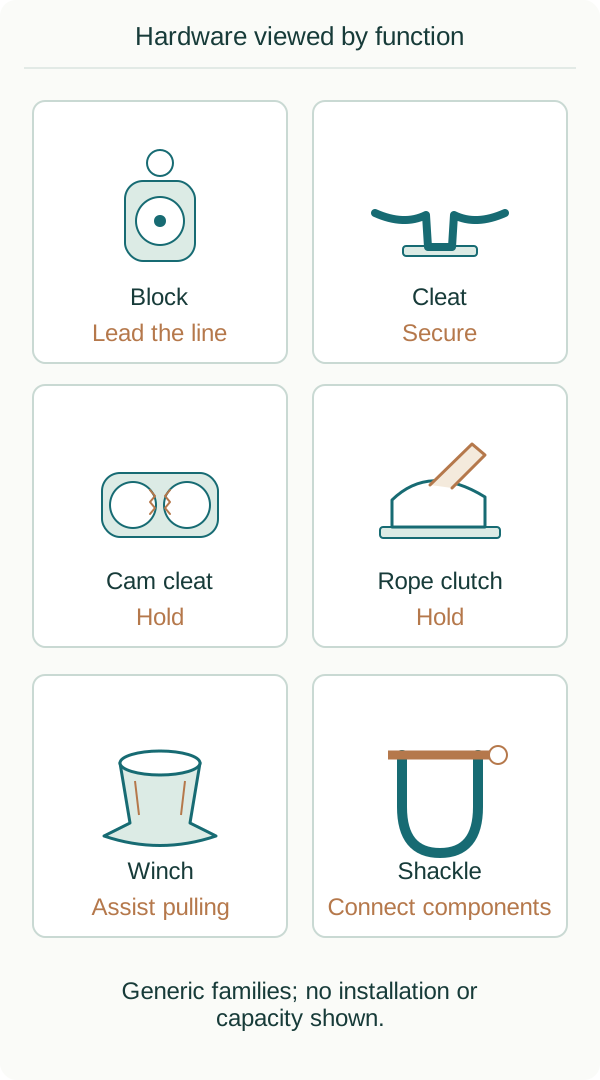
Original family drawings, without a brand, load capacity, compatibility or operating sequence.
insideSailOriginal insideSail artwork — all rights reservedEnlarge the diagram
Hardware looks like a complicated catalogue if you begin with brands and models. First organise it by function: leading a line, holding it, connecting elements or assisting effort.
A part may contribute to more than one relationship, and families contain variants. These drawings are generic, not copied commercial products or components sized for an installation.
Their classification helps interpret names and ask questions about a system.
The shapes explain different jobs
In the drawing, the sheave has a line-running surface and rotates within the block; the body holds it in the assembly. The depicted cleat has a base and horns around which a line can be secured.
A cam cleat has elements gripping the line; a rope clutch is another holding family, represented here by a body and handle. A shackle has a body and pin closing the connection between elements.
The illustrated manual winch presents a drum around which the line works, associated with mechanical transmission that provides a force advantage between manual effort at the handle and line tension. These names distinguish part, assembly and purpose without providing operating instructions.
Imagine a fictional inventory containing a block, a spare sheave and a shackle: three entries do not mean three blocks. The family name makes the inventory intelligible; a product reference adds the actual detail.
Generic shapes vary between products and retain only the introductory job explained here. Recognising each role also clarifies why a connector, a holder and a turning element cannot be treated as interchangeable simply because all participate in one line system.
Leading: block and sheave
A sheave is the rotating element; a block is the assembly incorporating it in the illustrated family. Distinguishing part and assembly improves an equipment list.
A catalogue may state sheave count, construction, dimensions and application. A small photograph establishes none of those fields.
The general job of leading a line does not make every block equivalent.
Holding: cleat, cam cleat and clutch
A cleat is a fitting associated with securing a line according to its documented use. A cam cleat and a rope clutch use different holding arrangements.
Recognising the family does not teach operation or load transfer. One product’s instructions do not automatically apply to a nearby lookalike.
A useful description separates family name, model reference and installed system.
| Family | Role in this reading | Common English term |
|---|---|---|
| Block / sheave | Lead a line and distinguish assembly from part. | Block / sheave. |
| Cleat | Identify a securing fitting. | Cleat. |
| Cam cleat | Distinguish one holding family. | Cam cleat. |
| Rope clutch | Distinguish another holding family. | Rope clutch. |
| Shackle | Connect elements in the documented assembly. | Shackle. |
| Winch | Assist effort on a line. | Winch. |
Connecting and assisting pulling are different jobs
A shackle identifies a connecting element; a winch identifies a different component type. Neither is selected by colour or apparent size.
Fairleads, eyes and other elements may complete line paths, but a simplified figure does not show the entire installation. Portuguese terms vary with context and usage.
When a document names a winch, retaining that term alongside its job can be clearer than imposing one equivalent on all pulling equipment.
Worked example: a box of parts
The example explains why manufacturers provide product-specific documentation. A clutch page may present instructions, tables and variants; a winch page may link its own manual.
Here these documents establish identity and scope without adopting capacities or recommending brands. The existence of a holding table tells us about the document; concluding that a component suits a boat is a different assessment.
Three things to remember
- Learn the job before the commercial reference.
- Part, assembly and system are different levels.
- Visual similarity establishes neither compatibility nor operation.
Concepts in this lesson
Block
An assembly incorporating one or more sheaves to lead a line. The assembly is distinct from each sheave within it.
Cam cleat
A holding-fitting family with cam elements gripping the line. It is distinct from a horn cleat and a rope clutch.
Cleat
A fitting for securing a line, with a base and horns in the illustrated form. Use belongs to the system and product documentation.
Rope clutch
A line-holding equipment family represented in the lesson by a body and handle. Operation and compatibility are product- and system-specific.
Shackle
A connecting element with a body and pin closing the assembly. Its family names a connecting job, distinct from leading or holding a line.
Sheave
A rotating element with a line-running surface, as in the illustrated block. It identifies a part rather than the whole assembly.
Sailing winch
Drum equipment used to apply tension to a line. In the manual example, handle and mechanical transmission provide a force advantage. This definition retains the sail-handling context.
Sources and references
- Winch Handle — User and Maintenance Manual MWH-00 ↗
Harken · Printed p.14, section 9.2 Power ratio; p.4 Intended use confirms sailboat context.
Only the mechanical-leverage principle is used, without numerical ratios, operating steps, maintenance instructions or reproduced diagrams. Edition date not inferred.
Checked on - Plain bearing blocks ↗
Seldén Mast · Applications; Features PBB 70/80; component variants.
Product identity and vocabulary only; load ratings and installation suitability are not adopted.
Checked on - EVO Self Tailing Winch ↗
Lewmar · Product identity; Resources including B2303 issue 14.
Website and document identity checked; operating and servicing instructions are not validated or reproduced.
Checked on - Cam cleats ↗
Seldén Mast · Cam cleats; size variants 27/38.
Product family identity only; no installation or operation recommendation.
Checked on - XAS — rope clutch ↗
Spinlock · Product Info; Specification; Documents — instructions, holding table, drill guides.
Product-specific documentation example; no capacity, price or compatibility recommendation.
Checked on
Keep discovering
The next piece of the puzzle
Discuss this concept
Loading the conversation…