By insideSail
Published without technical review · version 2 ·
An unintended gybe: relative wind and swept space
A change in wind–heading relationship can move boom and mainsheet without crew intention.
In this guide
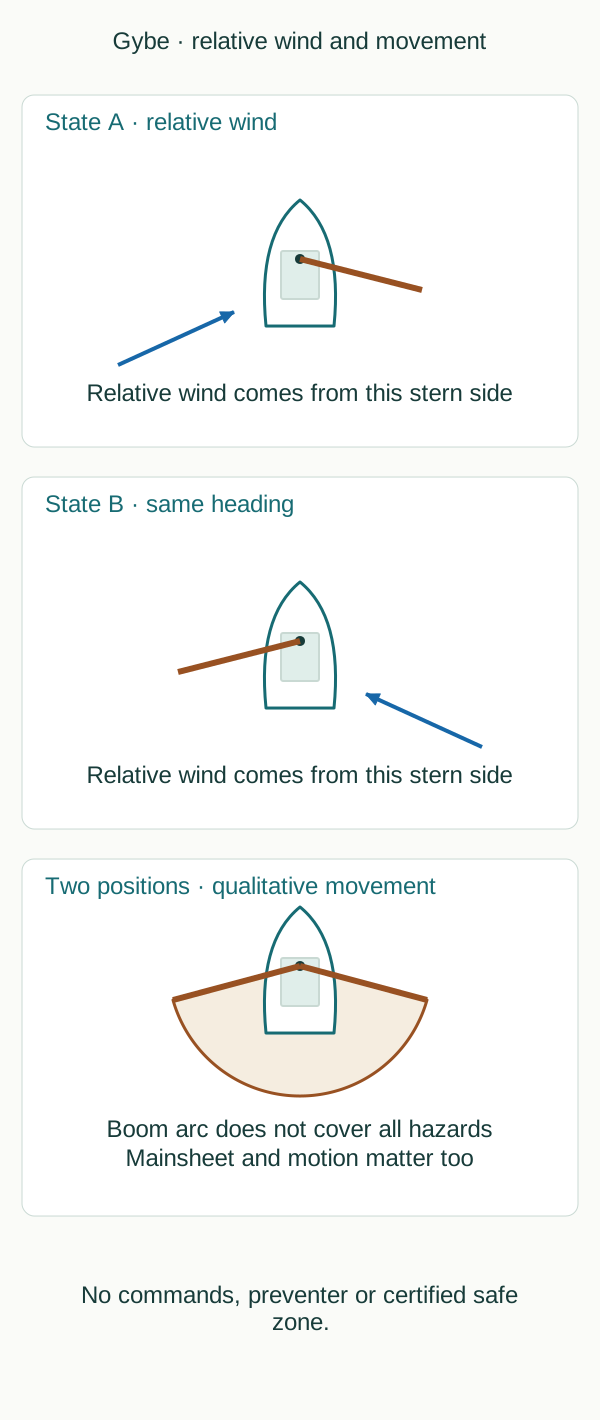
Original conceptual schematic, not to scale; fictional cases, not a manoeuvre procedure.
insideSailOriginal insideSail artwork — all rights reservedEnlarge the diagram
The wind relationship can change in two ways
Gybing describes a change of tack with the wind passing across the stern. That relationship can change because heading changes or because wind direction relative to the boat changes.
An unintended gybe need not have been announced as a manoeuvre. The two panels show static states with wind explicitly referenced to the boat, without track, speed or commands.
Their purpose is to separate human intention from physical change.
The boom supports the mainsail’s lower part and may move from one side to the other when loading changes. The mainsheet follows geometry depending on the installation: attachment point, tackle and traveller where fitted.
Drawing the boom alone is insufficient to understand everything that may move. Lines and vessel motion can create hazards beyond a direct strike by the rigid spar.
Swept space is not a small deck mark
The figure presents possible boom movement on a fictional boat. It is neither a certified danger-zone boundary nor an indication of where a person will be safe.
Height and reach vary between vessels, and mainsheet movement may occupy another region. A shorter person does not automatically gain protection: lines can strike them or vessel motion can unbalance them.
Speed and energy cannot be deduced from arc size in the drawing. Mass, sail area, loading, wind, sea state and control system influence the situation.
A small arc does not establish low severity, nor does a high boom eliminate every injury mechanism. The lesson avoids plausible force figures without testing because they could easily be mistaken for measurements from an actual boat model.
A real occurrence shows that the mainsheet matters too
The MAIB summary for Buccaneer of Upnor reports an unintended gybe in 2007 in which the mainsheet pushed a crewmember against the superstructure, causing fatal injuries. That fact belongs to the report; our drawing is fictional and reconstructs neither vessel nor accident.
The case demonstrates why describing the hazard only as hitting one’s head on the boom is incomplete. Coordinates, track and decisions are not imported as execution examples.
The same summary highlights crew capability and transfer of responsibility when someone goes below. These concern preparation and shared understanding, not equipment alone.
An informal instruction may leave unclear who monitors heading, wind and vessel response. Declared experience does not prove familiarity with the current installation.
Understanding the mechanism and roles should precede suitable practical training.
Additional protection creates a loaded system too
Devices and lines intended to limit or control movement have their own capacities, leads and limitations. No preventer installation, attachment point or release order is specified: a poorly understood arrangement can add loading and hazards.
A line attached to the boom does not establish valid protection. Suitability needs manufacturer instructions and competent assessment of the complete system.
The comparison distinguishes wind from movement too: a blue arrow represents air relative to the boat, while the arc covers boom positions. The arrow must not be read as a vessel track.
The same stated heading in both panels was chosen specifically to show a possible change in wind relationship without drawing a hull turn. These are two conditions, not frames in a prescribed manoeuvre sequence.
The aim is to identify relative wind, tack change, moving parts and exposed people without turning the diagram into a recipe. The case concerns an unintended change and its physical hazard paths.
Practical response and training depend on boat, conditions and capabilities; a static figure does not certify control of a loaded sail.
Sources and references
- Accidental gybe on cruiser racing yacht Buccaneer of Upnor with loss of 1 life ↗
Marine Accident Investigation Branch · Synopsis and Action taken; incident 22 August 2007, landing page published 23 January 2015; mainsheet impact and task transfer.
Actual report clearly distinguished from fictional diagram. No re-enactment, real track, names of casualties, or injury-mechanism certainty beyond official summary.
Checked on - MGN 592 (M+F) Amendment 2 — anchoring, mooring, towing or hauling equipment ↗
Maritime and Coastguard Agency · Sections 4.1–4.6 system loads and line direction; 5.1–5.5 bights and snap-back, whole-area risk and redirected leads.
Official guidance directly consulted for hazards and geometry; commercial procedures, turns, stoppering methods and loads not imported as yacht instructions.
Checked on
Keep discovering
The next piece of the puzzle
Discuss this concept
Loading the conversation…