By insideSail
Automated technical check · version 2 ·
Tacking and gybing: distinguish the geometry
Compare states and changes without an execution sequence.
In this guide
Wind is now arriving from the other side of the boat. This identifies a change but does not explain which one occurred.
A tack and a gybe can both change tack; they differ in how bow, stern and wind direction relate during the change. Understanding that geometry makes sailing descriptions easier to read.
The drawing compares conceptual states rather than tracing a manoeuvring path to follow.
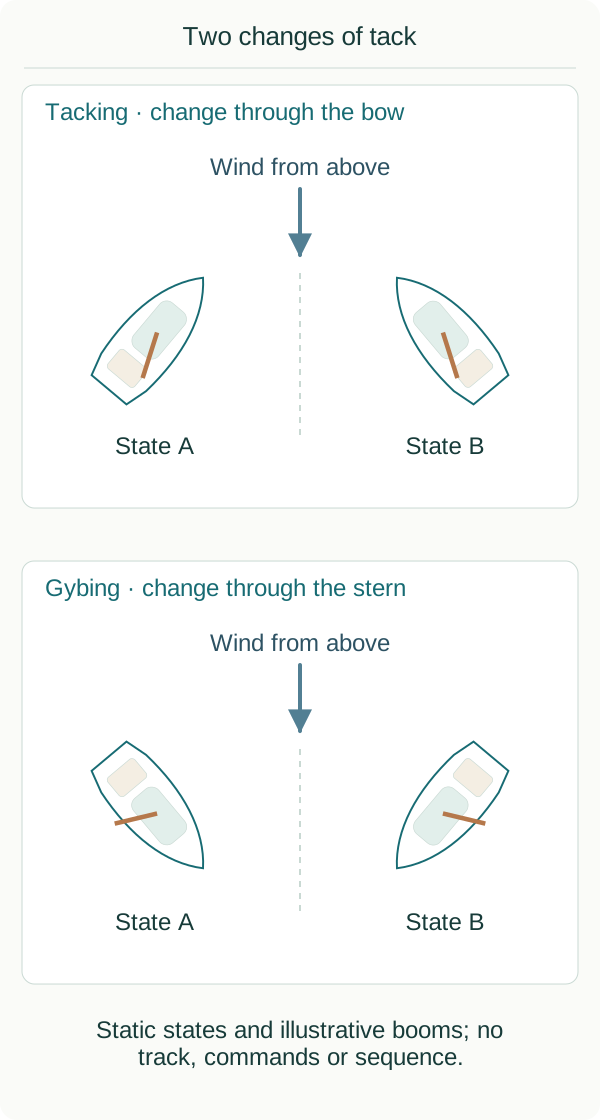
Geometric comparison of states, not an operating sequence or a track to follow.
insideSailOriginal insideSail artwork — all rights reservedEnlarge the diagram
When the relationship crosses the bow sector
In a tack, the bow crosses the direction from which the wind comes. Before and after, wind arrives on different sides.
This describes the relative change rather than hand positions, control order or each sail’s exact movement. Portuguese training uses virar de bordo; adding por davante makes the sector explicit in this example rather than leaving the side change as the only information.
When the relationship crosses the stern sector
In a gybe, the stern crosses the direction from which wind comes. The boat is in a downwind-sector relationship during that change, and the wind-and-sail relationship can pass from one side to the other.
Boom and sails have associated movements depending on the configuration. Identifying the conceptual change does not establish how to control those movements; that belongs to practical teaching.
Cambar is paired with virar de bordo in the consulted Portuguese sailing-training reference. Conversational usage can nevertheless be broader than this comparison.
The caption therefore retains gybe and the physical description of the stern. This is not a legal equivalence or a priority rule.
The aim is to make a sentence sufficiently informative even when someone uses vocabulary from another tradition.
A heading change does not always change tack
A boat can change heading within the same relative wind sector while continuing to receive wind on the same side. That changes orientation without producing the tack change described in these examples.
Conversely, wind can change direction while heading remains fixed, altering the relative relationship. Heading, wind and sail position are related variables; holding one fixed helps explain the role of the others.
The final state does not tell the whole story
The distinction between state and change appears throughout seamanship. “It is running” describes a point of sail; “it gybed” describes an event.
A photograph can help identify a state, while a contextual sequence can reveal a change. Naming an event also does not establish intention, correct execution or suitability for the conditions.
Those are assessment levels separate from the geometry explained here.
Takeaways
- Tack and gybe differ in which relative sector crosses the wind’s origin.
- Final state and the history of a change are different information.
- The drawing explains vocabulary; movement, controls and coordination require practical teaching.
Concepts in this lesson
Gybing
A change in the tack relationship in which the stern crosses the direction from which wind comes, in this lesson’s geometric comparison.
Tacking
A change of tack in which the bow crosses the direction from which wind comes, in this lesson’s geometric comparison.
Sources and references
- Do you know your points of sail? ↗
Royal Yachting Association · Point-of-sail names and their relationship to wind.
Names only. Fixed angles, universal fastest/easiest reach and trimming instructions are excluded.
Checked on - Referenciais de formação específica — Vela, Grau I ↗
FPV-hosted IPDJ training reference · Unit 7, section 7.1.6 b/c, printed p.26: virar de bordo and cambar.
Directly read for established Portuguese term pairing only; not evidence of current law, recognised competence or qualification.
Checked on - Gybe — glossary ↗
UK Sailmakers · Opening geometric definition: stern passes through the wind.
Only opening definition used; all later handling, safety and sail-control procedures excluded.
Checked on
Keep discovering
The next piece of the puzzle
Discuss this concept
Loading the conversation…