By insideSail
Published without technical review · version 2 ·
Anchoring: height, rode length and swinging room
A worked calculation separates a geometric ratio from actual anchoring capability.
In this guide
Water depth is not the entire vertical distance from the rode’s exit point to the seabed. That point is usually above water, and level can change during the stay.
Scope is deployed rode length divided by this vertical distance. Calculating it does not select a safe value: rode, anchor, bottom, conditions, location and system require their own assessment.
The calculation teaches what belongs in the denominator.
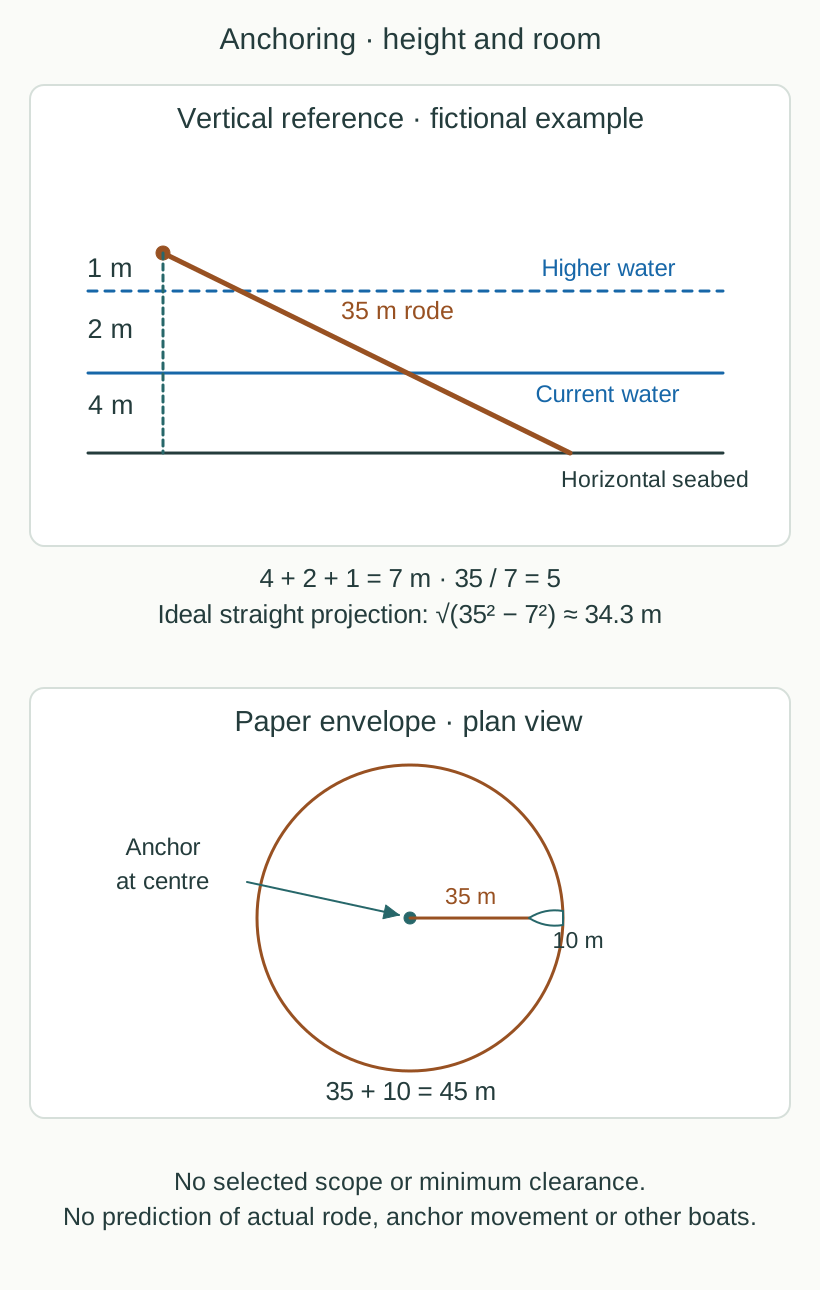
Original teaching illustration; bounded case, not to scale. See the lesson’s assumptions and limits.
insideSailOriginal insideSail artwork — all rights reservedEnlarge the diagram
The relationship in numbers
Scope = rode length / vertical distance to seabed
Lengths in the same unit; dimensionless ratio.
A calculation with declared references
This calculation begins with declared present water depth. Starting with a charted depth referred to chart datum would require the appropriate tidal height instead.
Do not add a rise twice or treat an instrument reading as depth from the surface without knowing its offset. Record reference, time and source.
Water-height calculation connects to navigation lessons without replacing current local information.
Deployed length also occupies space
For an ideal straight, taut rode, 35 m of length and 7 m vertical separation give horizontal projection √(35² − 7²), approximately 34.3 m. This is not an actual chain curve, which can touch the seabed and sag.
Projection merely separates along-rope length from horizontal separation. For a fictional 10 m boat extending that radius, a conservative paper envelope uses 35 + 10 = 45 m from anchor to the farthest end.
Neither 34.3 nor 45 m is a real minimum clearance. The drawing omits anchor movement, additional rode, obstacles, other boats and unknown positions of their anchors.
Boats with different rodes may not swing together. Overlapping paper circles do not prove inevitable collision but need investigation; separated circles with uncertain data do not prove safety.
Alongside free space, check restrictions and sensitive habitats using local information.
The complete process includes checking
Accompanied learning follows location and condition assessment, system and crew preparation, controlled deployment, setting and verification, and continued monitoring. Each phase has an observable outcome; deploying a calculated length does not establish holding.
Windlass, connections and load points follow their own documentation. Recovery also needs planning, keeping hands clear of machinery and rope clear of propulsion.
This adds geometry to existing preparation while sizing and execution require training on the actual system.
Sources and references
- Scope vs catenary ↗
Rocna Knowledge Base · Opening definition; Practical matters: vertical seabed-to-roller distance, possible high-water scenario; page revision oldid=2493.
Primary manufacturer explanation directly read. Only the measurement reference is used; product comparisons, chain-sizing claims and suggested universal scope multipliers are excluded.
Checked on - Boat Crew Handbook — Seamanship Fundamentals BCH 16114.4 ↗
United States Coast Guard · Chapter 6 J.14.a Length of Rode (Scope); J.11–J.19: preparation, setting and checking.
Primary dated handbook directly read. It defines scope relative to water depth; the roller-height refinement is sourced separately to Rocna. Operational ratios and engine/bitt prescriptions are not imported as yacht instructions.
Checked on - Anchoring with care ↗
Royal Yachting Association / The Green Blue · Seagrass; anchoring guidance; pivot area and protected habitats.
Live official page read. Published chain multipliers are not used as universal anchoring recommendations.
Checked on
Keep discovering
The next piece of the puzzle
Discuss this concept
Loading the conversation…