By insideSail
Published without technical review · version 2 ·
Anchoring: prepare the system and confirm the result
Deploying an anchor proves neither holding, swinging clearance nor watchkeeping.
In this guide
Anchoring requires a suitable location, compatible assembly, controlled execution and subsequent checking. An anchor does not act alone: bottom, depth, expected water level, wind, current, rode and securing points influence the assembly.
A community scope rule replaces none of those conditions. This lesson prepares supervised practice without universal rode ratios, proof loads or a windlass sequence transferred between models.
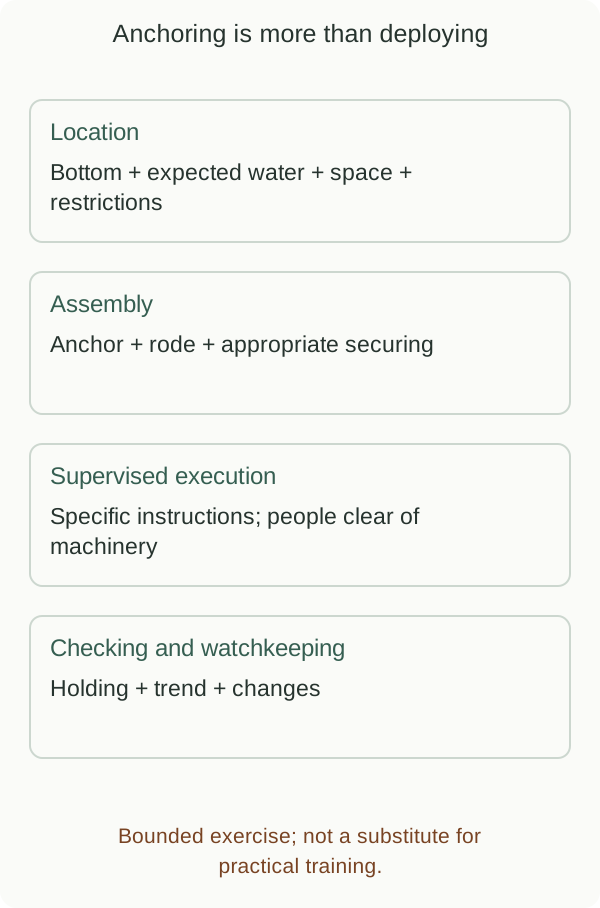
Bounded exercise; not a substitute for practical training.
insideSailOriginal insideSail artwork — all rights reservedEnlarge the diagram
Assess the location using appropriate sources
Depth needs reference level, tide state and expected variation. Swinging clearance includes vessel and assembly rather than only the anchor’s touchdown point.
Neighbours, hazards, shelter and direction changes matter. Planning includes departure if circumstances change.
Appropriate charts, publications and nautical warnings support choice; tourist marina reviews or calm-water photographs establish neither bottom conditions nor anchorage suitability.
Environmental effects and local restrictions are conditions, not optional details after selection. Anchors and sweeping rode can damage sensitive habitats.
RYA guidance uses UK examples; protected-area rules elsewhere need the relevant authority and current reference. This lesson depicts no actual seabed and declares no location permissible.
Practice can compare a documented suitable location with one lacking information without inventing the answer.
Prepare and keep people clear of machinery
Identify anchor, rode, connections, deployment system and the point receiving the anchored boat’s load. Windlass and securing point differ.
The consulted Lewmar manual distinguishes anchor handling from independent rode securing; convenience does not turn a windlass into a bollard. The actual installation must establish a suitable solution.
Keep hands, feet, hair and clothing clear of movement and potentially loaded routing. Do not reach into powered machinery to free a jam.
Briefing confirms helming, bow-area observation and communication. Rode routing needs understanding relative to propulsion rather than relying on handholding near a propeller.
Commands need clear recipients. Deployment and retrieval follow identified equipment and training; this text prescribes no clutch use, manual release or wiring.
An anchor on the bow does not complete preparation when its system remains misunderstood.
Confirm and continue observing
After supervised execution, distinguish holding, position and development. One photograph of a shore reference proves no absence of dragging over time.
Instruments can support watchkeeping, but settings, position error or power loss limit alarms. An electronic warning does not automatically remove human observation responsibilities.
Wind, water, neighbours and assembly changes need reassessment while retaining the ability to act.
Preparation can distinguish anchor location, possible vessel positions with its rode and documented hazards. Without dimensions and conditions, those positions permit no anchoring decision; they reveal point-versus-used-space distinctions.
Changing water level requires revisiting depth and geometry rather than treating one reading as the whole period. This lesson instructs no arbitrary increase in scope.
An instructor integrates equipment and conditions into a specific solution. Watchkeeping considers trend and change, not an isolated confirmation.
Community records should state observation method and interval while remaining separate from official data. An anchor listed on an OwnerBoat establishes neither readiness nor compatibility of the assembly.
The question of independent securing must also retain actual installation evidence rather than treating every fitting near the windlass as a suitable load-bearing point.
Sources and references
- Yacht sailing and motorboating ↗
RNLI · Safety checklist: training, briefing, weather and shore contact.
Read for preparation and bounded training. No comparative statistics or emergency procedure copied.
Checked on - Anchoring and mooring ↗
Royal Yachting Association · Opening guidance: seabed habitat, local protected areas and anchoring impact.
Environmental preparation only; UK protected-area examples do not establish Portuguese prohibitions.
Checked on - V 1–V 6 Windlass — 65001201 Issue 11 ↗
Lewmar · Printed p.3 §2 Safety Notice; §4.3 gypsy/rode suitability.
Official linked English manual directly consulted. Hazards and distinction between windlass and independent securing point; no installation or electrical procedure.
Checked on
Keep discovering
The next piece of the puzzle
Discuss this concept
Loading the conversation…