By insideSail
Published without technical review · version 2 ·
Berthing: prepare, communicate and retain an alternative
Planning includes interruption, not only arrival at the berth.
In this guide
Berthing combines steering, propulsion, environment, geometry and people. A video sequence may depend on twin engines, clear space or different wind.
Recognise boat and conditions before selecting an approach with a competent instructor. This lesson supplies no universal angle, speed or line order.
Practice focuses on preparation and decisions preventing continuation of an uncontrolled approach.
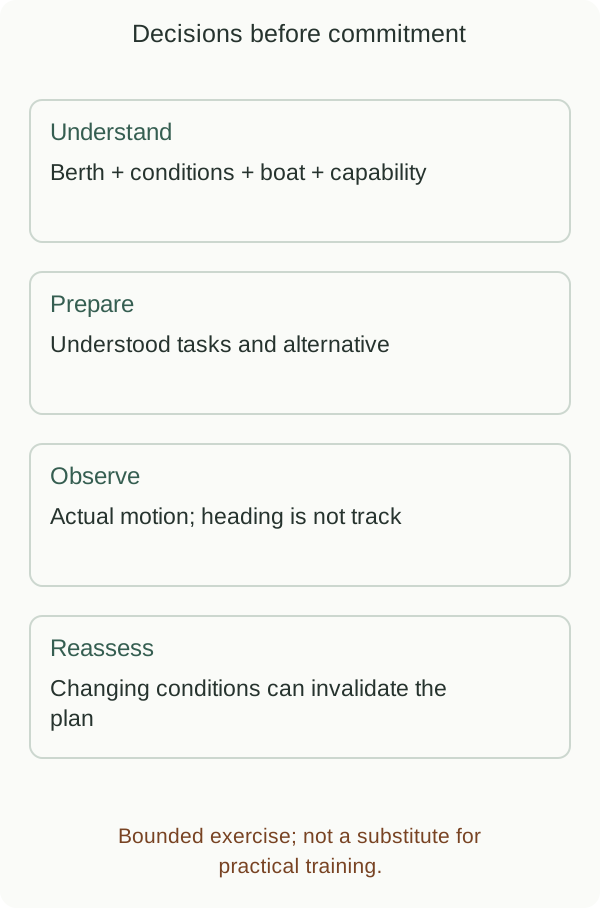
Bounded exercise; not a substitute for practical training.
insideSailOriginal insideSail artwork — all rights reservedEnlarge the diagram
Read the berth before committing
Identify berth type, relevant depth, obstructions, traffic and likely contact. A gangway establishes neither pontoon level nor a finger’s attachment capacity.
Stern-to berths may have a pre-laid line whose presence, position and propeller relationship need clarification with the marina. Do not assume availability or another person’s ability to keep it clear of propulsion.
Early questions belong to the manoeuvre rather than demonstrate incompetence.
Observe wind and movement relative to the berth without confusing heading with actual track. Engine and rudder response should already be understood through open-space training.
Reducing a control does not remove inertia, and astern response may differ from ahead. The chosen approach needs adequate margin and conditions compatible with competence and equipment.
A rescue-boat manual does not validate identical response in a long-keel yacht.
A short, understood briefing
Assign tasks people can actually perform. Describe expected contact, identified line and how to report inability.
Confirm nobody will jump ashore, stretch between surfaces or stop the vessel bodily. Shore assistance helps when coordinated, but availability does not justify assigning danger to an unknown person.
The helmsman must retain lookout; a line discussion cannot divert attention from space and traffic.
- Beforehand: understand berth, conditions, boat and alternative.
- Briefing: tasks, confirmations and stop signal.
- During approach: observe actual motion and report changes.
- If margin is lost: use the alternative already assessed with the instructor.
- Afterwards: check securing and discuss what changed.
An alternative must be viable before earning that name. “Go back” may not work after entering a narrow corridor with limited propulsion.
Decision points retain time and control. Training cards changing wind or removing a helper reveal when the plan fails.
Do not simulate an actual failure in a constricted passage. Repeat under controlled conditions, space and supervision before a busy marina.
A tabletop exercise can use a berth plan and three cards delivered at different times. One confirms expected information, one adds an obstruction and one removes crew capability.
At each stage ask what is known, which assumption changed and whether the alternative retains space. The drawing supplies neither a track nor gear commands.
This separates decision practice from engine-specific instruction; the instructor then connects questions with bounded practice aboard. Debrief communication, perceived motion and margin rather than only whether the yacht ended beside the quay.
An apparently successful arrival can conceal unnecessary exposure or misunderstood work. Identifying those problems is more useful than a general talent score for the helmsman.
Another berth, current or helper requires renewed assessment rather than repetition justified by the earlier outcome.
Sources and references
- Yacht sailing and motorboating ↗
RNLI · Safety checklist: training, briefing, weather and shore contact.
Read for preparation and bounded training. No comparative statistics or emergency procedure copied.
Checked on - Boat Crew Handbook — Seamanship Fundamentals BCH 16114.4 ↗
United States Coast Guard · Chapter 2 D.2; Chapter 6 D.1–D.2 pp.6-68–6-71: preparation, line identity and context. Chapter 6 A.9–A.12, printed pp.6-8–6-12: momentum, propeller action and rudder flow.
USCG operational scope, not European law. Installation dimensions, compulsory line counts, universal manoeuvres and twin-engine examples are not imported. Physical distinctions only; no universal prop-walk direction, pivot point, rpm, stopping distance or engine command sequence.
Checked on - Med mooring: stern-to ↗
Royal Yachting Association · Introduction; berth configuration; lazy-line identity and propeller interaction.
Official page directly read. Historical-general claims of negligible Mediterranean tide and universal boat-length/line-order instructions are not adopted.
Checked on
Keep discovering
The next piece of the puzzle
Discuss this concept
Loading the conversation…