By insideSail
Published without technical review · version 2 ·
Mooring: prepare lines, fenders and people
Preparation by function prevents using a body in place of a fender.
In this guide
Lines restrain movement, fenders separate surfaces and people communicate and act. All three functions need preparation but are not interchangeable.
Nobody should stop a boat with hands, feet or body between hull and pontoon. Mass and inertia make apparently slow movement injurious.
This lesson organises supervised preparation aboard an identified boat without prescribing universal line arrangement, sizes or attachment points.
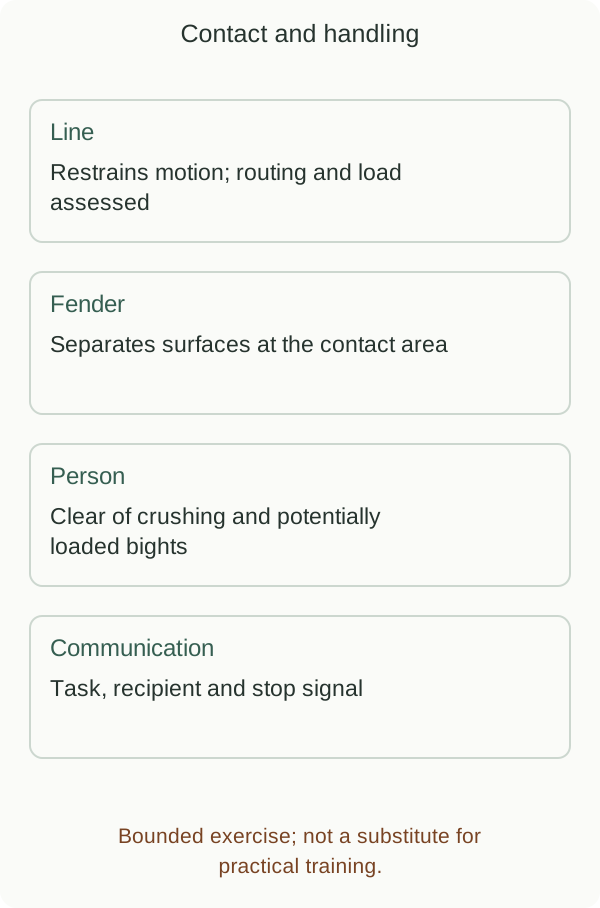
Bounded exercise; not a substitute for practical training.
insideSailOriginal insideSail artwork — all rights reservedEnlarge the diagram
Understand berth and expected movement
Floating pontoons, fixed quays and stern-to berths have different geometry. Water level, wash, wind, current and traffic alter contact and movement.
Fenders must suit the surface and likely contact area rather than count as effective merely because they hang aboard. Another boat’s photograph teaches no installation.
An instructor relates circumstances to the actual vessel, products and suitable points.
Follow each line from vessel to shore and ask what movement it restrains. Springs address longitudinal movement while other paths may restrain separation or combined movement.
Diagonals can act in multiple directions. Length, elasticity and routing affect response without providing capacity from a drawing.
Sturdy appearance does not establish assessed attachment strength. Identify function and destination so two people do not interpret one request differently.
Prepare handling without creating traps
Deck bights can tighten suddenly. Do not stand in a bight or wrap a potentially loaded line around hand or body.
Keep hands and clothing away from pinch points and machinery. Tensioned lines can fail or release energy; a fixed diagrammatic boundary creates no universal safe zone.
Assessment includes routing, possible movements, people and task. Handling beyond control is not solved by gripping closer to danger.
- In training, identify line and attachment before assigning the task.
- Agree confirmations and a clear stop signal.
- Prepare routing without lines in the water near propulsion.
- Keep people outside hull-to-quay contact.
- Review the assembly after securing and when conditions change.
On a training plan, identify what moves as the vessel separates and what may tighten as it approaches. Paper helps locate people in possible paths without representing loads or a safe snap-back distance.
A line crossing a walking area also matters after manoeuvring ends. Visitors may not understand that a harmless unloaded bight becomes dangerous with movement; explain before assigning handling.
Fender assessment considers surface and possible contact range rather than adjustment between converging surfaces. An instructor chooses demonstration without crushing exposure.
Final records identify conditions and unresolved questions, including water-level variation, instead of concluding “safe mooring” from a stationary photograph. A later configuration change must be assessed as changed, not assumed equivalent because the number of lines and fenders remains the same.
Once secured, movement, tide and wind changes may require competent reassessment. Do not leave without understanding whether lines remain suitable for expected variation.
This lesson teaches neither engine-and-spring manoeuvres nor releasing loaded lines. Those applications need specific instruction and assessment.
Sources and references
- Rope care advice ↗
Marlow Ropes · Care in Use; Terminations; Inspection and Retirement.
Official page directly consulted. No cleaning chemistry, temperature, numerical load reduction, universal lifespan or splicing recipe. Appearance alone is not a strength assessment.
Checked on - Boat Crew Handbook — Seamanship Fundamentals BCH 16114.4 ↗
United States Coast Guard · Chapter 2 D.2; Chapter 6 D.1–D.2 pp.6-68–6-71: preparation, line identity and context.
USCG operational scope, not European law. Installation dimensions, compulsory line counts, universal manoeuvres and twin-engine examples are not imported.
Checked on - Med mooring: stern-to ↗
Royal Yachting Association · Introduction; berth configuration; lazy-line identity and propeller interaction.
Official page directly read. Historical-general claims of negligible Mediterranean tide and universal boat-length/line-order instructions are not adopted.
Checked on
Keep discovering
The next piece of the puzzle
Discuss this concept
Loading the conversation…