By insideSail
Automated technical check · version 2 ·
Lines and fenders: tension and contact are different jobs
Read the functions on an already-moored boat without copying an arrangement.
In this guide
A sailboat beside a pontoon may have lines at its ends, lines nearly parallel to the hull and fenders along its side. These are not interchangeable accessories.
Lines establish connections and transmit tension; fenders work between surfaces approaching one another. This distinction explains why many visible fenders do not describe the mooring arrangement, while counting lines does not describe contact between hull and pontoon.
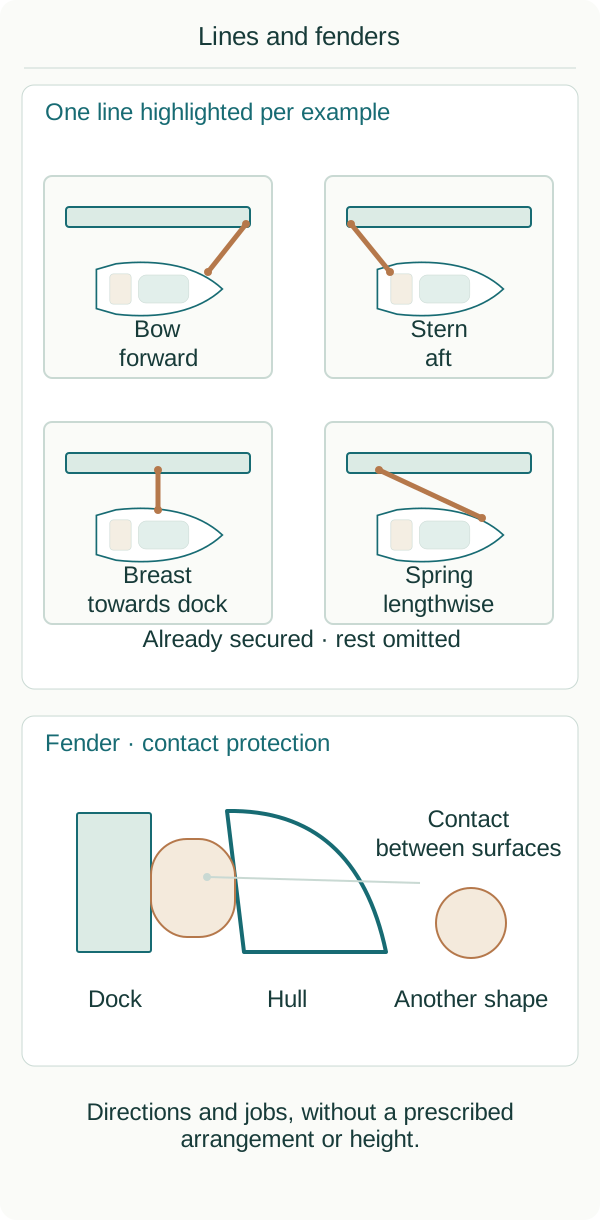
Each excerpt highlights one line of an already secured boat. The rest is omitted; this is not a recommended arrangement.
insideSailOriginal insideSail artwork — all rights reservedEnlarge the diagram
A line transmits force along a connection
In the simplest model, a taut line pulls along the direction connecting its attachment points. It does not push like a rigid strut.
If it lies obliquely to the boat’s axis, one tension can have longitudinal and transverse components. The complete direction, rather than its name alone, explains those components.
The drawing uses static line positions to make this geometry readable without quantifying forces or sizing components.
Bow line and stern line identify relationships with those areas of the boat. A breast line has an approximately transverse direction between the side and shore.
A spring runs more longitudinally and participates in restraining forward or backward movement. Exact arrangements and local names vary.
In a description, “attached at the bow and leading aft on the pontoon” adds information that the word spring alone does not contain.
A fender works where contact occurs
Fenders are intended to separate surfaces and cushion contact. In a deformable fender, compression changes its shape as contact develops.
This differs from transmitting tension between two mooring points. A line suspending a fender helps maintain its position; it does not turn the fender into a mooring line.
The drawing separates these functions rather than suggesting that one element replaces the other.
Fender families include cylindrical, spherical and other shapes. Shape changes contact geometry and the volume available for deformation, but appearance does not determine capacity or suitability.
A hull’s shape differs between locations, and its neighbour may be a wall, pontoon edge or another hull. “There is a fender between the boats” is therefore an observation; understanding contact also requires identifying the surfaces and their relationship.
Two readings of a static example
The reading changes when the reference changes. The boat can move relative to the pontoon, while both can rise relative to a fixed structure as water level changes.
A plan view shows horizontal relationships but omits the vertical dimension. Connecting views makes the drawing useful.
Lines and fenders belong to a moving assembly even when a photograph gives the impression of an entirely still scene.
Takeaways
- Line tension and fender compression are different physical relationships.
- Direction and attachment points explain more than counting elements.
- The figure describes functions; distribution, sizing and operation require practical review.
Concepts in this lesson
Fender
A component intended to separate surfaces and cushion contact; its function differs from transmitting tension through a mooring line.
Mooring line
A line establishing a mooring connection and transmitting tension along its path; attachment points and direction explain the physical relationship.
Spring line
A mooring line leading more longitudinally and participating in restraint of forward or aft movement; its actual arrangement needs identification.
Sources and references
- Basic Rescue Boat Operator Manual — June 2023 ↗
International Maritime Rescue Federation · Printed p.89, section 8.8: spring and breast-line labels; printed p.92: anchor/rode component relationship.
Official PDF selected text supplied from the independent source review and read locally on 10 October 2026. Vocabulary only; SAR procedures, claimed universal handling responses, anchoring suitability and line arrangements excluded.
Checked on - User Guide — Fendering ↗
Polyform AS · Fendering section: cylindrical/spherical forms, hull and local context.
Product-family and contact-function context only. Inflation pressures, number/size guidance, mooring limits and cleaning excluded.
Checked on
Keep discovering
The next piece of the puzzle
Discuss this concept
Loading the conversation…