By insideSail
Automated technical check · version 2 ·
Quays, pontoons and berths: read the space around the boat
Static geometry, fixed structures and relative movement.
In this guide
A marina berth is more than a rectangle with available length. It involves a relationship between the hull, nearby structures, shore access and water level.
Describing a boat as alongside, bows-to or stern-to explains part of that relationship. It does not yet describe the arrival path, mooring arrangement or suitability of the berth.
Start with the geometry that these words actually identify.
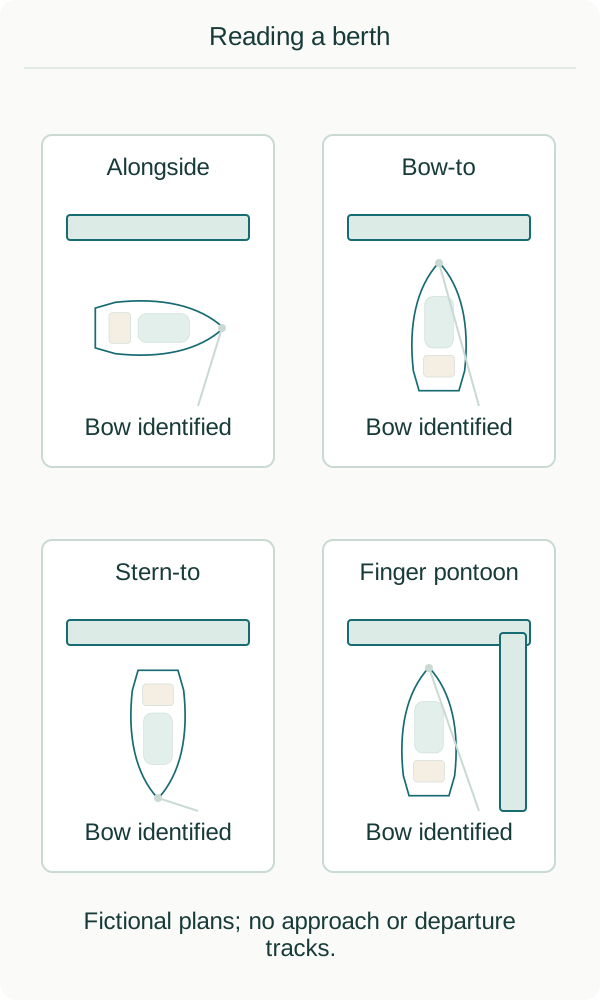
Original unscaled plans without tracks, an actual location or compatibility assessment.
insideSailOriginal insideSail artwork — all rights reservedEnlarge the diagram
Three relationships seen from above
Alongside places the hull’s longitudinal axis approximately parallel to the neighbouring structure. Bows-to presents the bow towards the shore.
Stern-to presents the stern towards it. These relationships are not geographical bearings: rotating the plan preserves the same description.
They also do not identify the side from which the boat entered. Final geometry and the sequence producing it are separate pieces of information.
A finger is a narrow pontoon extension providing a side edge beside one or more berths. A main pontoon may give access to several fingers.
On a plan this looks like lines and rectangles; in the actual space, the surfaces have height, width and movement. Berth here names the space allocated to the boat, not the sleeping place that the same English word can describe inside a cabin.
A side view adds another dimension
A fixed structure retains its position relative to land. A floating pontoon follows water level within the characteristics of its system.
The boat also floats but should not be imagined as rigidly fixed to the pontoon. Level changes can alter the relationship between deck and a fixed edge; local movements can alter the relationship between hull and pontoon.
Complementary views help distinguish these situations.
Tide and current are not synonyms. The former includes periodic level change; the latter describes water movement.
A photograph showing a low waterline on a wall does not give the current’s speed at that instant. Likewise, knowing that a pontoon floats does not establish available depth.
These distinctions allow a coherent description without turning visual clues into information that has not been measured.
A plan-and-profile example
Access and connection are complementary questions
Shore access relates two spaces, while lines relate mooring points. At a stern-to berth, access may be associated with the stern area; alongside, it may occur along the side.
Identifying an access location helps explain the assembly but does not assess stability, height, condition or use. A useful caption keeps berth space, present structures and observed connections separate.
This vocabulary also helps compare marina information without confusing availability with compatibility. A price by length band describes a commercial rule; it does not automatically describe beam, draught or layout limits at a particular berth.
An individual boat’s dimensions and a berth’s limits are fields separate from price. Separating what each field measures or classifies prevents correct information from answering the wrong question.
Takeaways
- Boat orientation and structure type are independent information.
- Plan and profile show different relationships.
- Berth geometry is neither a berthing instruction nor an access assessment.
Concepts in this lesson
Berth
Space allocated to a boat beside a structure or within a mooring system. In this context, berth does not mean an interior sleeping place.
Finger pontoon
A narrow pontoon extension providing a side edge beside one or more berths.
Sources and references
- What is the difference between a tide and a current? ↗
NOAA National Ocean Service · Explanatory paragraphs: vertical tidal level and horizontal water movement.
Page reports updated 23 September 2026. Definitions only; not a local forecast or timing rule.
Checked on - Med mooring: stern-to ↗
Royal Yachting Association · Opening Med mooring paragraphs; distinction between shore lines and installed bow mooring.
Static layout vocabulary only. No approach, lazy-line retrieval, engine, anchor or crew sequence; no universal Mediterranean tidal claim.
Checked on
Keep discovering
The next piece of the puzzle
Discuss this concept
Loading the conversation…