By insideSail
Published without technical review · version 2 ·
Bowline: build and follow a fixed loop
A practice sequence separates the small nipping loop, large eye and working end.
In this guide
A bowline forms an eye rather than a running noose. Its geometry is worth learning before choosing an application.
Here the rope remains unloaded on a table, with no person or equipment attached. The large eye is the opening being formed; the knot’s small nipping loop performs another job.
Confusing them makes a memorised story difficult to check. The sequence shows the path rather than an application for rescue, lifting or towing.
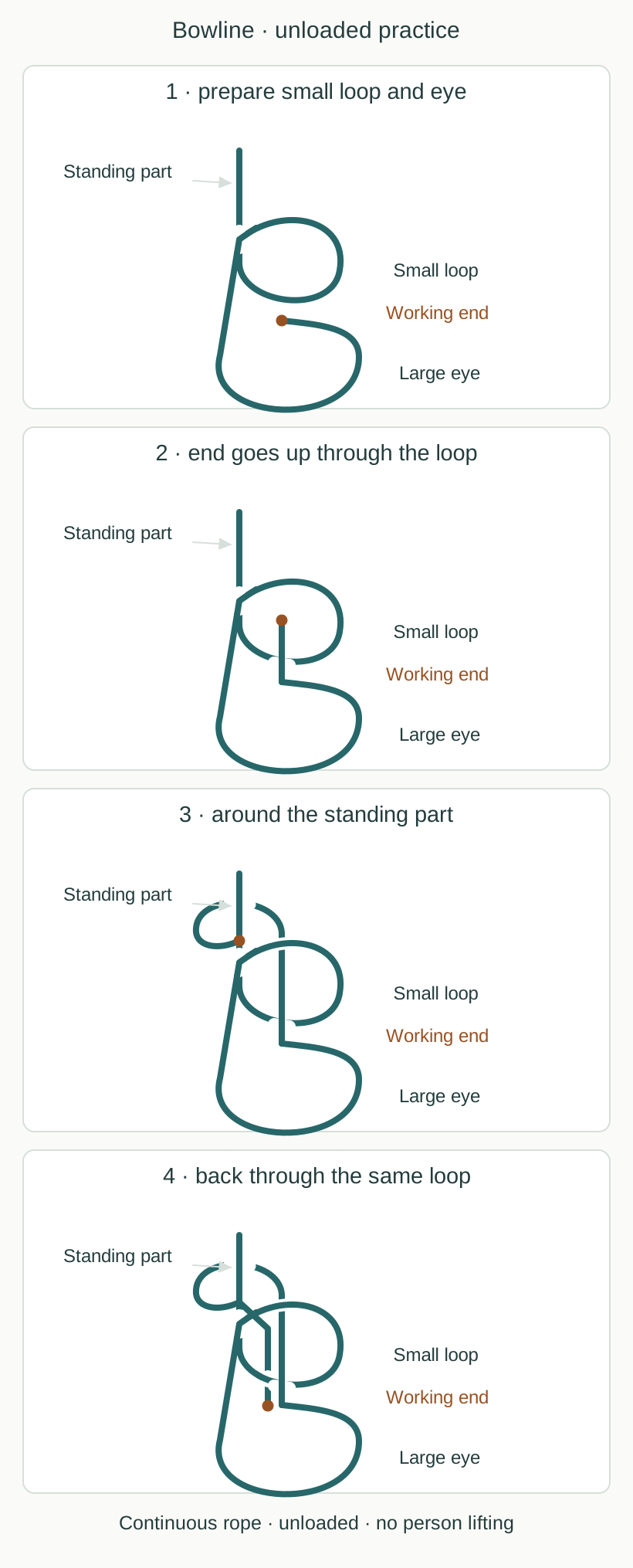
Original teaching illustration; bounded case, not to scale. See the lesson’s assumptions and limits.
insideSailOriginal insideSail artwork — all rights reservedEnlarge the diagram
Prepare a rope whose path can be followed
Identify the working end and standing part. A temporary paper marker can distinguish the end during practice.
Keep the rope clear of edges and machinery, with the loop open. A visual break marks the segment passing behind; the actual rope remains continuous.
Two ropes are not joined at that crossing. Illustrated tail length is neither a service measurement nor proof of adequate allowance for any material.
Four states, one rope
- Form the small loop in the standing part, allowing the following segment to form the large eye.
- Bring the working end up from the large eye through the small loop.
- Take the working end around the standing part and return through the same small loop in the opposite direction.
- Dress the curves without load and trace the end: through, around and back; the tail lies inside the large eye.
The large eye can be wider or narrower without changing crossing order. Rotating the whole knot on the table does not change its identity either.
Replacing an overpass with an underpass can change the knot. Initially keep the drawing’s orientation when checking; then rotate the rope and repeat the inspection.
Recognising the structure from both sides is more useful than depending on one photograph viewed from one position.
An explained mistake
What still needs learning
Recognition does not select an application. Rope type, condition, changing load, orientation and possible loosening matter.
A bowline can loosen in some conditions; a drawing supports no claim that it never slips. Personal safety systems may require specific terminations and checks.
Do not replace instructions with this sequence or apply a load to persuade someone. Reading prepares competent training rather than authorising a person to be lifted.
Afterwards you should be able to identify both ends, standing part, small loop and large eye; explain each crossing; and show where an error changed the path. Preserve the distinction between unloaded construction and selecting a service termination.
The previously introduced figure-eight, this fixed eye and hitches around a support serve different purposes. They are not difficulty levels making the most complicated automatically best.
Sources and references
- Rope care advice ↗
Marlow Ropes · Terminations; Inspection and Retirement; Care in Use.
Primary manufacturer guidance consulted. No universal strength reduction, lifespan or service tail length.
Checked on - Boat Crew Handbook — Seamanship Fundamentals BCH 16114.4 ↗
United States Coast Guard · December 2017, C.5.a–e, printed pp.2-24–2-28; Figures 2-10, 2-12 and 2-14.
Official PDF downloaded and complete selected pages visually read. Rope topology only; operational USCG uses and broad holding claims are not adopted. Original coordinate drawings, not traced figures.
Checked on
Keep discovering
The next piece of the puzzle
Discuss this concept
Loading the conversation…