By insideSail
Published without technical review · version 2 ·
Figure-eight: unloaded practice and checking
Following one continuous rope is more useful than memorising a silhouette.
In this guide
The figure-eight is a stopper-knot form. This exercise uses unloaded practice rope on a table, unconnected to people, sails or moorings.
Learning its path distinguishes a knot from decorative geometry without proving suitability in actual equipment. Application, material, diameter, clearance and release requirements need assessment.
A competent instructor should accompany learning before real use.
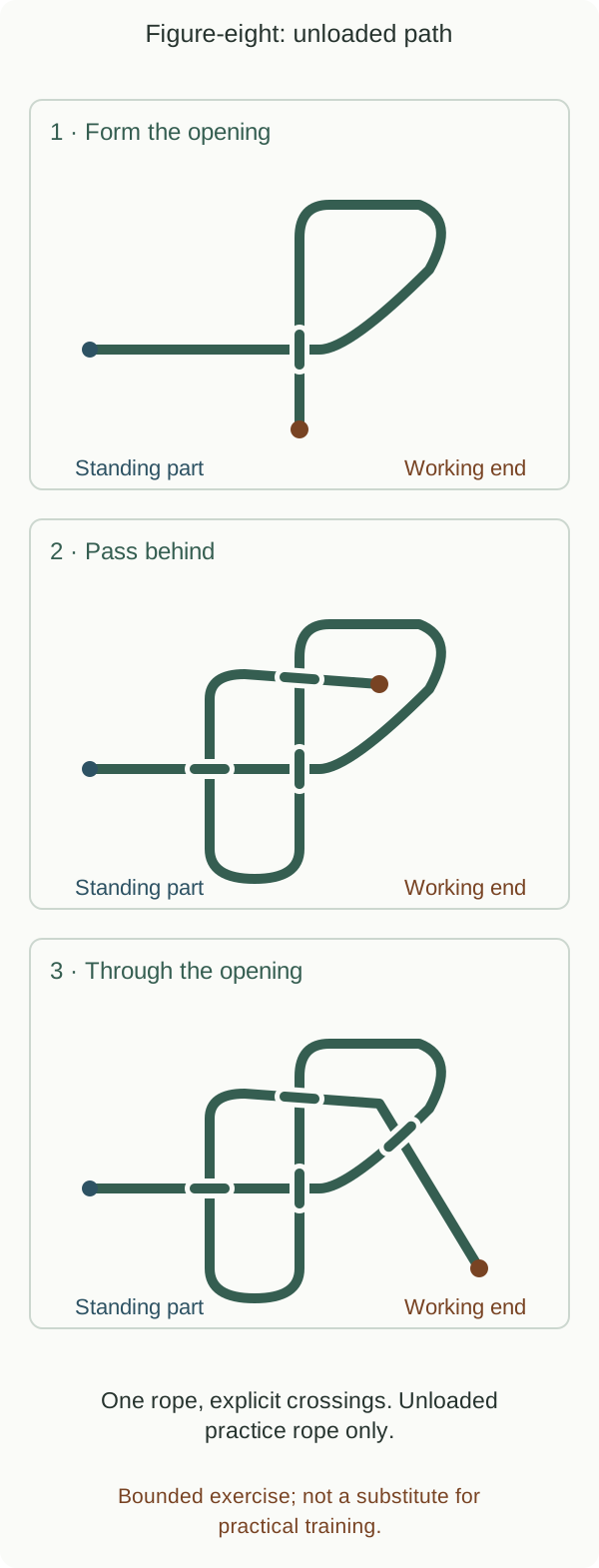
Bounded exercise; not a substitute for practical training.
insideSailOriginal insideSail artwork — all rights reservedEnlarge the diagram
Identify parts before beginning
Choose a working end and identify the remaining standing part. The drawing uses one continuous rope and marks over-and-under crossings.
Those differences matter: intersecting lines on paper without overlap information do not determine a knot. Leave room to follow the path and identify the initial opening.
The illustrated tail length is graphical, not a minimum service dimension or universal safety criterion.
A bounded sequence
- Cross the working end over the standing part to form the initial opening.
- Take the working end behind and around the standing part.
- Bring it forwards and pass it through the initial opening.
- Dress the path, draw the curves together without load and follow the entire rope to check.
The final passage must not use whichever gap looks convenient. Initial opening and turn around the standing part have defined relationships.
A figure-eight and an overhand knot differ: the additional turn changes the path. Practise slowly, return to earlier states and compare the drawing.
If the complete rope cannot be followed, undo and repeat with guidance instead of tightening ambiguous geometry. Tight dressing can conceal errors visible in an open path.
What checking establishes and what it does not
Practice checking confirms continuity and crossings, identifies both ends and distinguishes accidental twists. It measures no strength and certifies no termination.
Knots affect assembly capacity according to rope and knot rather than one percentage for every material. Equipment requiring free release may prohibit a stopper.
Learning a figure-eight does not override a specific system’s “no stopper knot” instruction.
To assess continuity, mark the working end while retaining that this is one rope rather than separate coloured components. A partner follows its complete route on the drawing without touching a loaded line.
Compare open and dressed states: relevant crossings do not change merely as curves draw together. A mirrored final form can still represent the knot; mirroring differs from swapping only one over-and-under crossing.
Assessment should identify that difference rather than demand a photograph’s exact orientation. Do not infer service tail length from graphic spacing.
Another construction or application reopens compatibility and procedure questions. This exercise establishes geometry and explanation only, granting no competence in splicing, towing, lifting or strength assessment.
Identifying an error is an appropriate learning result even when an attractive final silhouette initially looks familiar.
Other knots, hitches and splices address different functions. Bowlines, clove hitches and joining knots are not replaced by a figure-eight merely because they are harder to remember.
Selection and loaded application require further appropriate training. Never use this lesson to hoist a person, attach a harness or join towlines.
Sources and references
- Hints and Advice on Rigging and Tuning ↗
Seldén Mast · Printed pp.12–14 Running rigging; p.56 Slab-reefing boom.
Official PDF downloaded and selected full pages read on 11 October 2026. Device-specific slab reef reference, not a universal recipe. No copied instructions, tuning, preventer installation or specified line length.
Checked on - Rope care advice ↗
Marlow Ropes · Care in Use; Terminations; Inspection and Retirement.
Official page directly consulted. No cleaning chemistry, temperature, numerical load reduction, universal lifespan or splicing recipe. Appearance alone is not a strength assessment.
Checked on - Boat Crew Handbook — Seamanship Fundamentals BCH 16114.4 ↗
United States Coast Guard · C.5.l, printed p.2-36, Figure 2-22: figure-eight topology; C.4–C.5 vocabulary.
Official PDF read and p.2-36 rasterised for visual inspection. Original coordinates, no tracing or copied figure. Only unloaded training topology; no claim of stopper suitability in any installed system or strength retention.
Checked on
Keep discovering
The next piece of the puzzle
Discuss this concept
Loading the conversation…