By insideSail
Automated technical check · version 2 ·
Knots, hitches and terminations: what is being connected?
A map of purposes and forms before practical execution.
In this guide
A rope can have a free end, an eye or a connection to another element. At first glance, these may all look like “a knot”.
The relationships differ, however: connecting a rope to itself, joining two ropes and connecting a rope to an object ask different questions. Understanding these families makes an inventory or instructor’s explanation clearer even before learning how to make any connection.
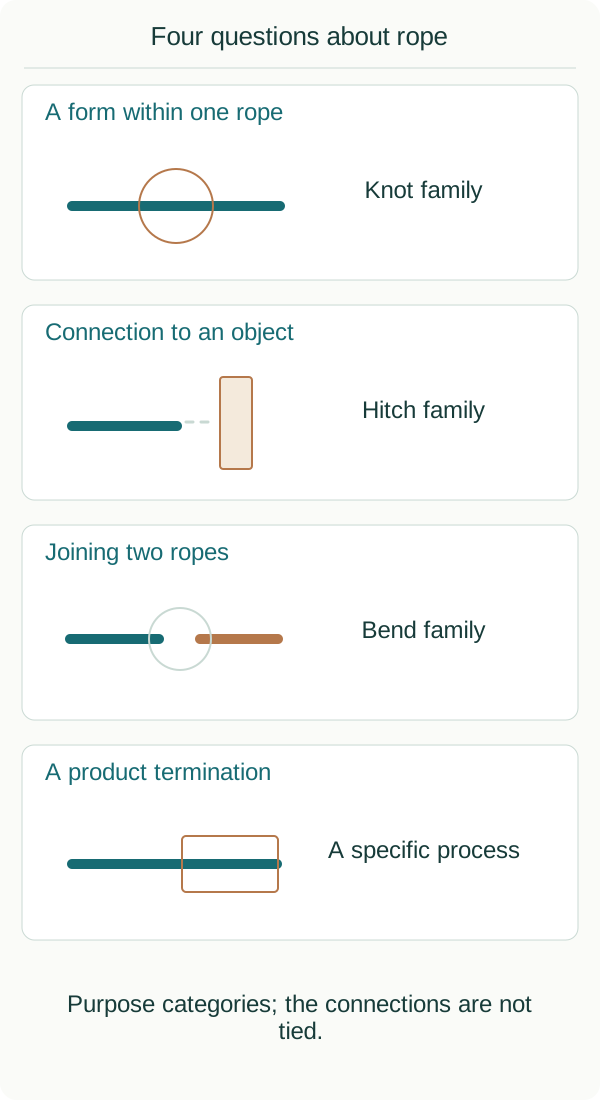
Categories without tied knots, completed connections or load applications.
insideSailOriginal insideSail artwork — all rights reservedEnlarge the diagram
| Documented English name | Named family |
|---|---|
| Figure eight — stopper knot | Stopper knot |
| Clove hitch | Rope-to-object connection |
| Sheet bend | Rope-to-rope connection |
Purpose organises the vocabulary
In English, knot can be a broad term, while bend commonly names a connection between ropes and hitch a connection to an object. Portuguese nó and volta have uses that depend on context and tradition.
This lesson states the purpose alongside the name. “A rope-to-object connection” is clearer for a beginner than translating hitch in isolation and expecting the translation to explain its entire geometry.
An eye is an opening formed at an end or within a connection. It describes a shape and position in the assembly rather than determining how it was made.
A splice works with elements of rope construction to create a joining or termination. A knot relates rope portions through bends and crossings.
These methods do not become equivalent merely because both can produce a similar-looking opening.
Shape, method and product are different layers
Termination is a broader description of how an end is finished or prepared for connection. It can involve different methods and components according to the product.
An end finish preventing unravelling does not necessarily perform the job of a connecting eye. A metal component associated with an end is another component with its own identity.
A description improves when it states what exists, where it is and its attributed function.
Recognising a name does not verify a connection
A connection has geometry, material, condition and a use context. Sharing a name does not make those layers irrelevant.
A purpose diagram omits precisely the information required to teach execution: order, complete path, finishing and checking. That is why the figure presents separate categories rather than a sequence of hands or arrows.
The learning outcome here is understanding a description, not reproducing an in-service connection.
Connection identity should also be separated from reported behaviour. “It jammed” may describe an experience of taking it apart rather than measuring strength.
“It was easy to make” describes one person’s experience rather than validating suitability. An experience can be useful when its context is retained and it is labelled accordingly.
Turning it into a universal rule would discard important information about the rope and its application.
This vocabulary connects with the materials chapter: core-and-cover, braided and laid construction remain meaningful after a termination is added. A photograph of an eye does not turn an unidentified rope into an identified product.
Conversely, knowing the material does not reveal how its connection was made. Purpose, construction and evidence are complementary questions, each helping explain what the next description still needs.
Takeaways
- Describe whether the connection relates rope to itself, another rope or an object.
- An eye is a shape; termination and splice add other information.
- Execution and suitability under load require practical learning and qualified review.
The concept in a few words
Rope termination
The way a rope end is finished or prepared for connection; shape alone does not determine method, capacity or suitability.
Sources and references
- Rope care advice ↗
Marlow Ropes · Terminations; Inspection; identification of condition-dependent care.
Only documentation/termination distinctions used. Cleaning, temperatures, inspection instructions, strength factors and retirement rules excluded.
Checked on - Boat Crew Handbook — Seamanship Fundamentals BCH 16114.4 ↗
United States Coast Guard · Chapter 2, C.3–C.4, printed pp.2-21–2-23: parts, loop, bight and vocabulary families; C.5.e p.2-28, C.5.h p.2-32 and C.5.l p.2-36: English knot names only.
Selected definitions and names only. Knot sequences, knot suitability assertions, load reductions and US operational requirements excluded.
Checked on
Keep discovering
The next piece of the puzzle
Discuss this concept
Loading the conversation…