By insideSail
Published without technical review · version 2 ·
Clove hitch: two turns and a crossing
Learning the path around a support does not guarantee security under changing load.
In this guide
A clove hitch relates two turns around a support through their crossing. This demonstration uses an unloaded practice cylinder unconnected to a boat.
It shows a working-end method with the support stationary. Two loops can also be formed and placed over an accessible end of a support, but that is a different method.
They are not mixed in a drawing that would prevent tracing one continuous rope.
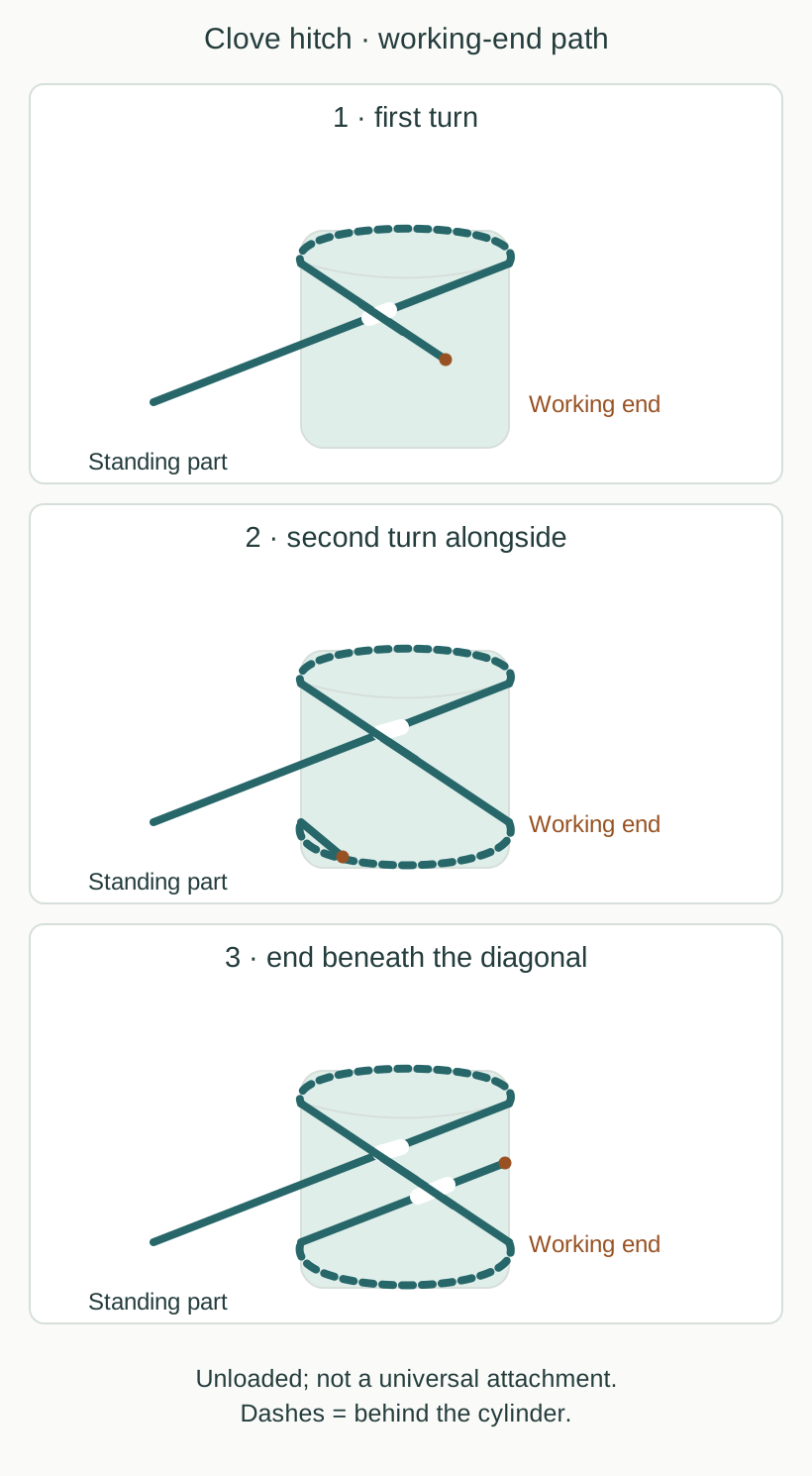
Original teaching illustration; bounded case, not to scale. See the lesson’s assumptions and limits.
insideSailOriginal insideSail artwork — all rights reservedEnlarge the diagram
A sequence around the support
- Make the first turn around the cylinder and cross the end over the standing part.
- Continue with a second turn around the cylinder beside the first.
- Pass the working end under the diagonal crossing the turns.
- Dress without load, showing both turns and the final passage beneath the crossing.
The drawing separates visible front portions from those hidden behind the cylinder. Dashes mark hidden portions; a small crossing gap identifies the underpassing line.
Neither denotes a join or cut. Trace from standing part to working end.
If an image omits overlap order, an attractive outline can represent different knots; checking therefore includes crossings rather than silhouette alone.
Counting turns is insufficient
Moving the turns along the cylinder need not change the path’s identity. Replacing one overpass with an underpass is not merely a spacing adjustment.
Keep both ends identified and change one feature at a time to distinguish those cases. This observational method also applies to the figure-eight and bowline: shape, size and topology are related without being synonyms.
Limits belong to a useful definition
A clove hitch can slip or loosen under some conditions, particularly with movement or changing load. It is not presented as a universal attachment, nor do two turns guarantee security.
Termination selection depends on rope, support, direction and purpose; an appropriate additional finish may be needed. A static picture does not select that finish.
The exercise is no harness attachment, person-lifting system or unverified permanent mooring.
A horn cleat and cylinder are different fittings. Belaying to a cleat and practising this hitch on a cylinder are not interchangeable instructions.
Identify the fitting and suitable method with an instructor before learning a mooring manoeuvre. This lesson’s specific outcome is identifying the first turn, second turn, diagonal and tail, and explaining why this is not an assessment of system capacity.
Sources and references
- Rope care advice ↗
Marlow Ropes · Terminations; Inspection and Retirement; Care in Use.
Primary manufacturer guidance consulted. No universal strength reduction, lifespan or service tail length.
Checked on - Boat Crew Handbook — Seamanship Fundamentals BCH 16114.4 ↗
United States Coast Guard · December 2017, C.5.a–e, printed pp.2-24–2-28; Figures 2-10, 2-12 and 2-14.
Official PDF downloaded and complete selected pages visually read. Rope topology only; operational USCG uses and broad holding claims are not adopted. Original coordinate drawings, not traced figures.
Checked on
Keep discovering
The next piece of the puzzle
Discuss this concept
Loading the conversation…