By insideSail
Published without technical review · version 2 ·
Round turn and two half-hitches: separate support and finish
The rope first encircles the support; the half-hitches surround its standing part.
In this guide
Here a rope encircles a support and finishes with two half-hitches around its own standing part. These are different relationships.
The drawing uses a tabletop training cylinder rather than a mooring bollard or rated attachment. Work unloaded with flexible practice rope and space to see the crossings.
The learning goal is tracing continuity: object, contact turn, first half-hitch and second half-hitch.
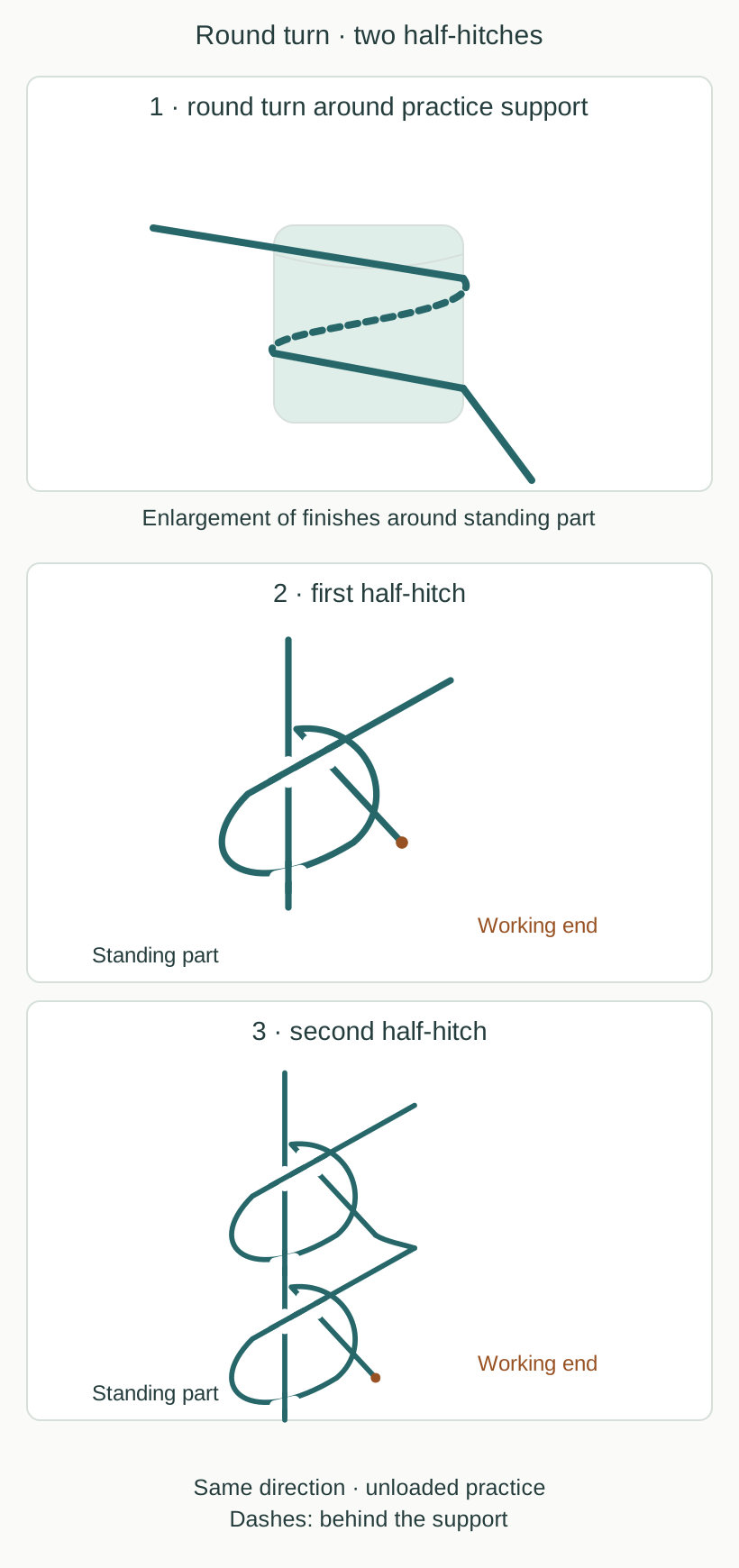
Original teaching illustration; bounded case, not to scale. See the lesson’s assumptions and limits.
insideSailOriginal insideSail artwork — all rights reservedEnlarge the diagram
Do not omit the initial turn
A round turn encircles the support rather than merely bending the rope aside. Trace the rope in front of and behind the cylinder during practice.
Dashed lines represent portions hidden by the support, not broken rope. The curves remain open to reveal the path rather than simulate actual friction.
Support and rope geometry affect contact; capacity cannot be inferred from the number of turns fitting in a picture.
- Encircle the support with a round turn, keeping standing part and working end identifiable.
- Take the end around the standing part and through the opening created by the end itself: first half-hitch.
- Repeat the relationship around the standing part: a second half-hitch in the same direction.
- Bring the hitches together and dress the unloaded rope; trace every passage again.
The half-hitches have a relationship
The diagram separates the hitches so they can be counted. In the dressed model they come together rather than become independent knots elsewhere in the rope.
Reversing one hitch produces a different final structure. Initially avoid memorising only “two turns”: turning around the support and hitching around the standing part are different operations.
Naming the working end’s route resolves ambiguity that counting movements does not.
Unloaded practice does not measure service behaviour
This exercise does not demonstrate releasing a loaded mooring. Support, diameter, material and load alter tightening, friction and handling.
Do not force a loaded rope free or place hands in a pinch point to reproduce a drawing. A fitting aboard or ashore needs identification and assessment rather than selection because it resembles the training cylinder.
Service selection belongs to the actual system and competent instruction.
Remember the organisation: turn around the support, two same-direction hitches around the standing part, and verifiable continuity. A bowline forms a fixed eye; this hitch relates the rope to a fitting.
Distinguishing them helps identify what to discuss with an instructor rather than treating every knot as one solution. Practical training adds handling, limits, inspection and suitable use absent from the tabletop model.
Sources and references
- Rope care advice ↗
Marlow Ropes · Terminations; Inspection and Retirement; Care in Use.
Primary manufacturer guidance consulted. No universal strength reduction, lifespan or service tail length.
Checked on - Boat Crew Handbook — Seamanship Fundamentals BCH 16114.4 ↗
United States Coast Guard · December 2017, C.5.a–e, printed pp.2-24–2-28; Figures 2-10, 2-12 and 2-14.
Official PDF downloaded and complete selected pages visually read. Rope topology only; operational USCG uses and broad holding claims are not adopted. Original coordinate drawings, not traced figures.
Checked on
Keep discovering
The next piece of the puzzle
Discuss this concept
Loading the conversation…