By insideSail
Published without technical review · version 2 ·
Coming alongside: track, rotation and room to leave
An annotated plan follows approach, alignment and departure in a bounded case.
In this guide
This example uses a conventional single-engine yacht, a straight clear quay and an instructor-selected approach. The drawing has no wind or current and assumes sufficient depth already verified.
These are teaching assumptions rather than presumptions about a marina. The plan shows hull position and orientation.
Actual movement over the ground still needs observing; bow direction alone does not describe the track.
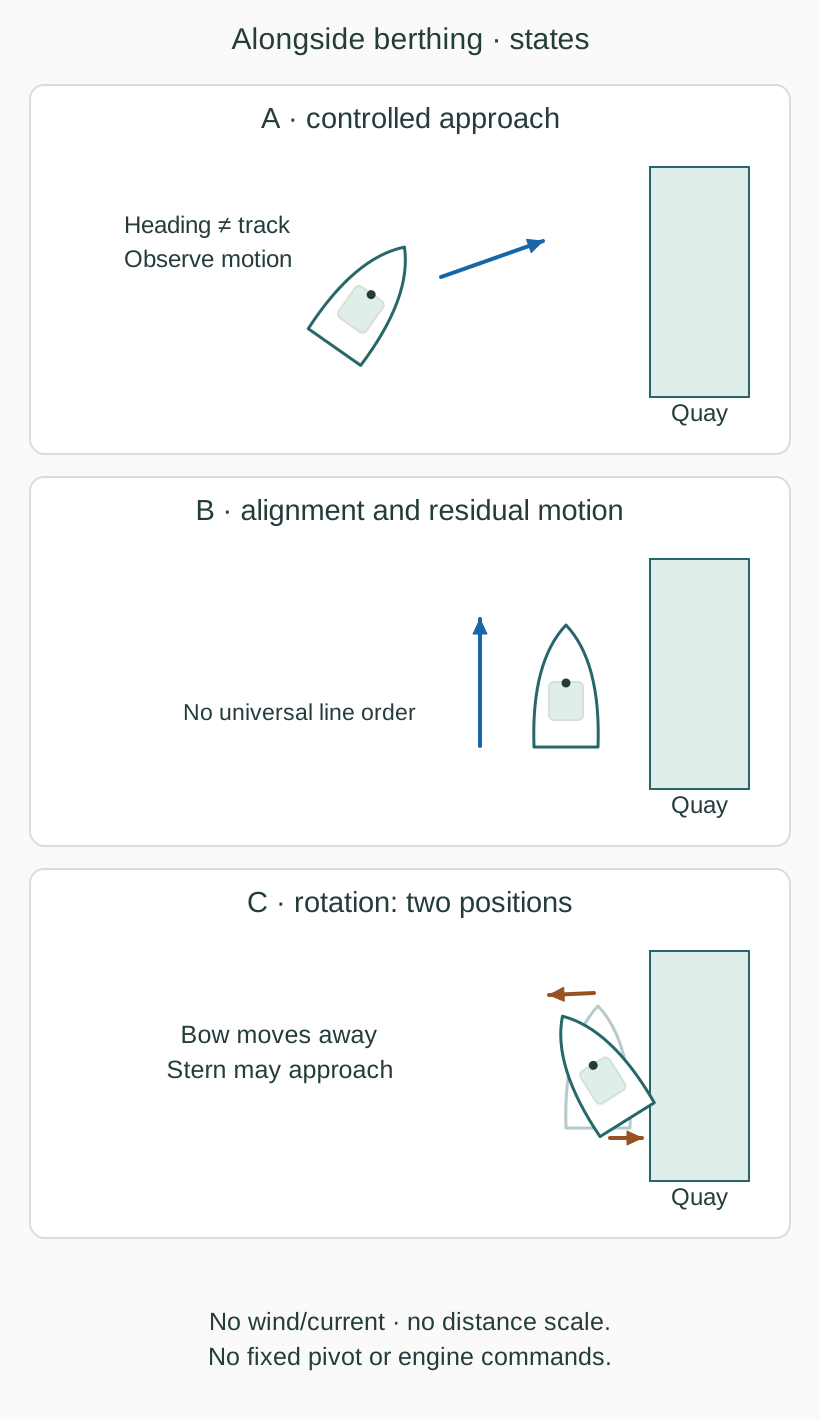
Original teaching illustration; bounded case, not to scale. See the lesson’s assumptions and limits.
insideSailOriginal insideSail artwork — all rights reservedEnlarge the diagram
Arrival: reduce commitment before contact
First identify berth, escape, contact surfaces, fenders, lines and people. Approach retains controlled speed and the ability to stop or leave.
Near the berth the boat progressively aligns with the quay rather than aiming its bow at contact until the final instant. Inertia carries the hull after thrust is removed; steering depends on flow and configuration.
Astern thrust to reduce ahead motion is appropriate only with that boat’s response understood and control retained.
Once aligned, residual motion and separation still need checking. A ready line does not authorise attachment to any fitting.
An instructor chooses order and points for the circumstances; the drawing prescribes neither “bow first” nor “stern first” universally. Shore assistance is coordinated, with no jumping or body between hull and quay.
Afterwards the secured arrangement is checked against movement, tide and duration.
Departure: the opposite end moves too
During hull rotation, bow and stern move in opposing lateral directions relative to that rotation. Moving the bow away can bring the stern towards the quay.
Overlaid positions of a fictional hull reveal this effect without fixing a universal pivot one-third along the length. Effective pivot and track depend on motion, forces and configuration.
The swept hull needs room, in addition to an apparently clear direction ahead.
A readable sequence without a universal recipe
- Prepare departure and confirm people, lines and available space.
- Release and recover lines according to the plan, keeping them clear of propulsion.
- Establish separation while observing bow, stern and actual motion.
- Continue only with control and room; stop and reassess when circumstances diverge.
Actual wind or current adds forces absent from this case. Different engines, propellers and keels also change response.
The drawing helps explain three outcomes — controlled approach, alignment and departure with a clear swept envelope — and identify missing room or control. Engine commands, angles, distances and line use are defined in real training with appropriate margins rather than improvised from SVG coordinates.
Sources and references
- Boat Crew Handbook — Seamanship Fundamentals BCH 16114.4 ↗
United States Coast Guard · Chapter 6 A.9–A.12 propulsion response; D.1–D.2, printed pp.6-68–6-71: docking preparation and approach.
Physical geometry and planning only. Rescue-vessel angles, twin-engine controls and USCG standard line counts are excluded.
Checked on - How to brief your crew ↗
Royal National Lifeboat Institution · 4 October 2019: role assignment, familiarisation and timely briefing before coming alongside.
Official article read. Original small-crew example is neither an RNLI exercise nor certification.
Checked on
Keep discovering
The next piece of the puzzle
Discuss this concept
Loading the conversation…