By insideSail
Published without technical review · version 2 ·
Under power: learn response through controlled practice
Control, force and movement need separate observation.
In this guide
An engine control changes propulsion operation; vessel motion follows forces and prior state. Neutral does not erase velocity and astern does not establish a universal stopping distance.
Steering depends on installation and flow around the rudder. Learn response in suitable space with an instructor, bounded conditions and preparation before a tight quay.
This lesson provides no throttle or gear-change recipe.
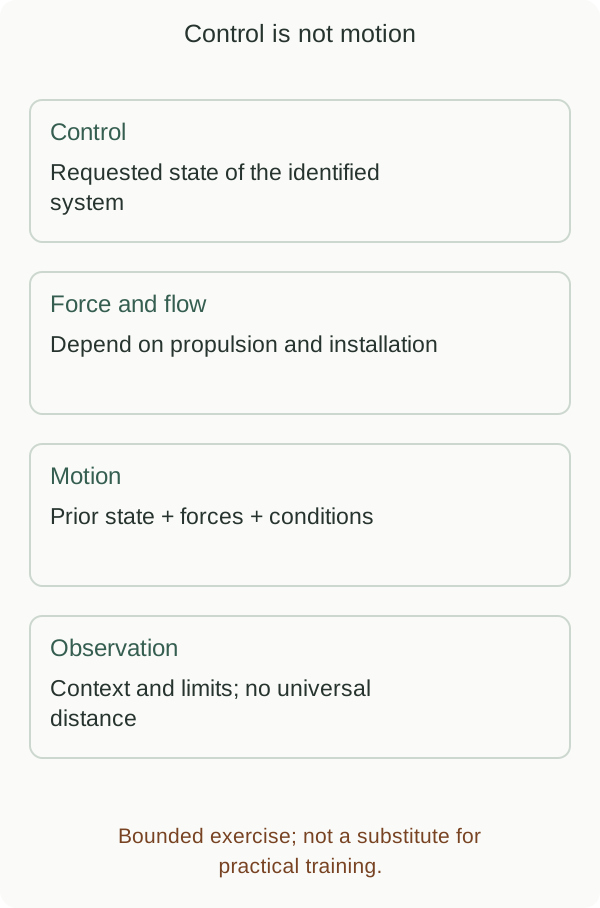
Bounded exercise; not a substitute for practical training.
insideSailOriginal insideSail artwork — all rights reservedEnlarge the diagram
Preparation belongs to the exercise
Identify engine, transmission and controls. Actual equipment instructions govern starting, alarms, cooling, operation and stopping; a repower may differ entirely from model specifications.
Crew know tasks and interruption method. Loose lines and people near propulsion are hazards rather than test instruments.
The instructor confirms location, traffic, space and suitable learning conditions. Do not choose an area with swimmers to observe propeller effects.
Separate command from event: control position, observed timing and relative displacement. Do not stare at a recording display while losing lookout.
An observer can help within available capacity. Results need load, wind, current and sea-state context.
Sheltered practice without current establishes no exposed-approach response. Experience data help when conditions and limits remain attached; they do not become model specifications.
Residual motion and rudder response
Moving mass remains relevant after a control change. Braking force needs time and depends on transmission, propeller and conditions.
A rudder needs relative flow and may respond weakly when flow diminishes. Installations receive propeller flow differently ahead and astern.
Steerable propulsion or twin engines change the analysis. The diagram distinguishes questions without universal prop-walk direction or fixed pivot point.
- Agree purpose, space and interruption with the instructor beforehand.
- Identify control and starting state while maintaining lookout.
- Perform only the agreed task with identified vessel and instructions.
- Observe response and residual motion without seeking a stronger effect.
- Return to controlled conditions and record context and limits.
Learning distinguishes bow orientation, longitudinal motion and possible lateral displacement. A boat can keep travelling one way while its bow rotates; a rudder drawing alone predicts no response.
Start with fictional data to learn description rather than seeking stronger effects afloat. Participants explain observations, commands and what could not be measured.
Perception delay, environment and faults are different hypotheses. Labelling every lateral movement “prop walk” resolves nothing.
Repetition requires the instructor, conditions and space to permit a bounded task. A report concerns that actual vessel and circumstances rather than every model sharing its horsepower.
Engine and transmission information retains version and modification identity. In particular, a repower can preserve the boat’s name while changing controls and response, so the earlier owner’s experience is a question to assess rather than a procedure to inherit.
Unexpected differences can emerge. Interrupt within the plan and obtain assessment rather than insist on repeated gear changes or treat alarms as nuisances.
Faults require equipment procedures and competent assistance. This chapter diagnoses or repairs no transmission.
Sources and references
- Yacht sailing and motorboating ↗
RNLI · Safety checklist: training, briefing, weather and shore contact.
Read for preparation and bounded training. No comparative statistics or emergency procedure copied.
Checked on - Boat Crew Handbook — Seamanship Fundamentals BCH 16114.4 ↗
United States Coast Guard · Chapter 6 A.9–A.12, printed pp.6-8–6-12: momentum, propeller action and rudder flow.
Physical distinctions only; no universal prop-walk direction, pivot point, rpm, stopping distance or engine command sequence.
Checked on
Keep discovering
The next piece of the puzzle
Discuss this concept
Loading the conversation…