By insideSail
Published without technical review · version 2 ·
Current: connect observation with reference frames
A north-pointing bow can coexist with a north-east track.
In this guide
Moving water allows different vessel motion through water and over ground. Heading describes orientation, not the resulting track.
This matters in navigation and approach observation: remaining berth clearance changes with actual motion. This lesson practises reading and adding vectors on a table before supervised application.
It supplies neither a route, local current prediction nor harbour-entry permission.
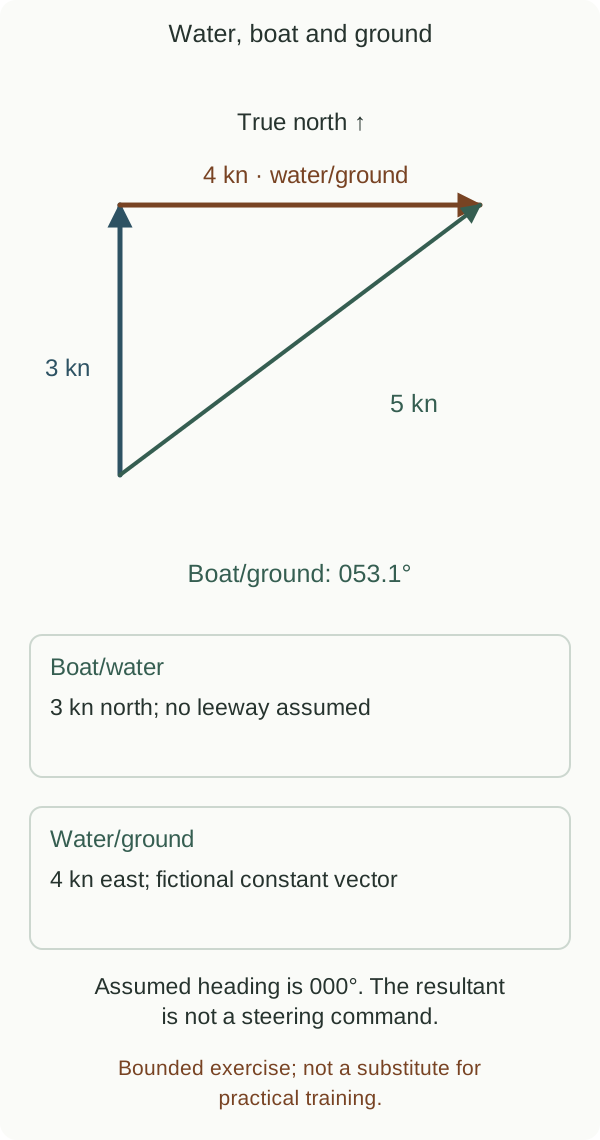
Bounded exercise; not a substitute for practical training.
insideSailOriginal insideSail artwork — all rights reservedEnlarge the diagram
Declare each arrow’s meaning
Velocity has magnitude and direction; knots express magnitude. Here movement arrows point where an object goes, unlike meteorological wind direction naming where it comes from.
All vectors use identical axes and true north on paper. Do not mix magnetic and true bearings or bow-relative angles and north-referenced azimuths.
Before calculation, state object, reference, unit and time.
The relationship in numbers
Boat/ground velocity = boat/water velocity + water/ground velocity
Vector addition in a common frame; ideal constant motion.
The right triangle exists only because the chosen components are perpendicular. Other directions need consistent decomposition rather than always adding magnitudes.
Same-direction velocities produce a different magnitude; opposing velocities can reduce it. Heading was an initial assumption, not a calculated compensation.
Do not turn 053.1° into a steering command. Passage planning still requires hazards, timing, forecasts, charts, variation and capability absent from this triangle.
Instruments and observation are not interchangeable labels
STW and SOG identify different frames while instruments have method, error and configuration. Their difference does not automatically measure the entire current: leeway, calibration, resolution and timing can intervene.
Identify data before concluding. Relative observation of a structure helps recognise motion without replacing lookout or establishing regional current.
Practice begins ashore and only moves afloat under suitable instruction and conditions.
Apparent wind relates air to boat. Current also affects the distinction between ground- and water-referenced wind.
Correct relationships use stated frames and vectors, not “true wind always equals forecast minus SOG”. The earlier conceptual lesson explains this.
Here participants identify data origin rather than recalibrate instruments to force agreement with an ideal calculation. Disagreement may expose unsuitable assumptions rather than equipment failure.
Draw the first arrow from the origin and the second from its endpoint while preserving direction and scale. The resultant joins origin to final point.
The 3–4–5 example checks both geometry and arithmetic without validating different inputs. Current changing direction during that hour produces a different displacement from a constant vector.
Heading was assumed with no leeway: the exercise neither estimated lateral angle nor established zero leeway aboard. Ask a partner to identify assumptions before accepting the conclusion.
A precise 053.1° result can look more trustworthy than its inputs. Keeping assumptions with the number prevents arithmetic precision becoming forecast precision.
Different measurement times or reference conventions invalidate simple comparison even when the display uses the same unit, so identification precedes calculation.
Current differs from tidal height; high or low water guarantees no local slack. Current information needs area, timing, reference and currency.
This fictional illustration is no navigation tool. The useful outcome is explaining why different arrows can describe one boat without contradiction.
Sources and references
- Glossary — sailing reference frames ↗
B&G · Heading, Apparent Wind, Boat Speed, Ground Wind and SOG entries.
Only reference-frame terminology used. Outdated constellation claims, universal leeway values and product settings are excluded.
Checked on - What is the difference between a tide and a current? ↗
NOAA National Ocean Service · Opening explanation: vertical tide versus horizontal flow; page updated 23 September 2026.
No local prediction or assertion that high/low water equals slack. Worked vectors below are original ideal examples.
Checked on
Keep discovering
The next piece of the puzzle
Discuss this concept
Loading the conversation…