By insideSail
Published without technical review · version 2 ·
Fixed quay and floating pontoon: what water level changes
The same connection can have different geometry when its supports do not rise together.
In this guide
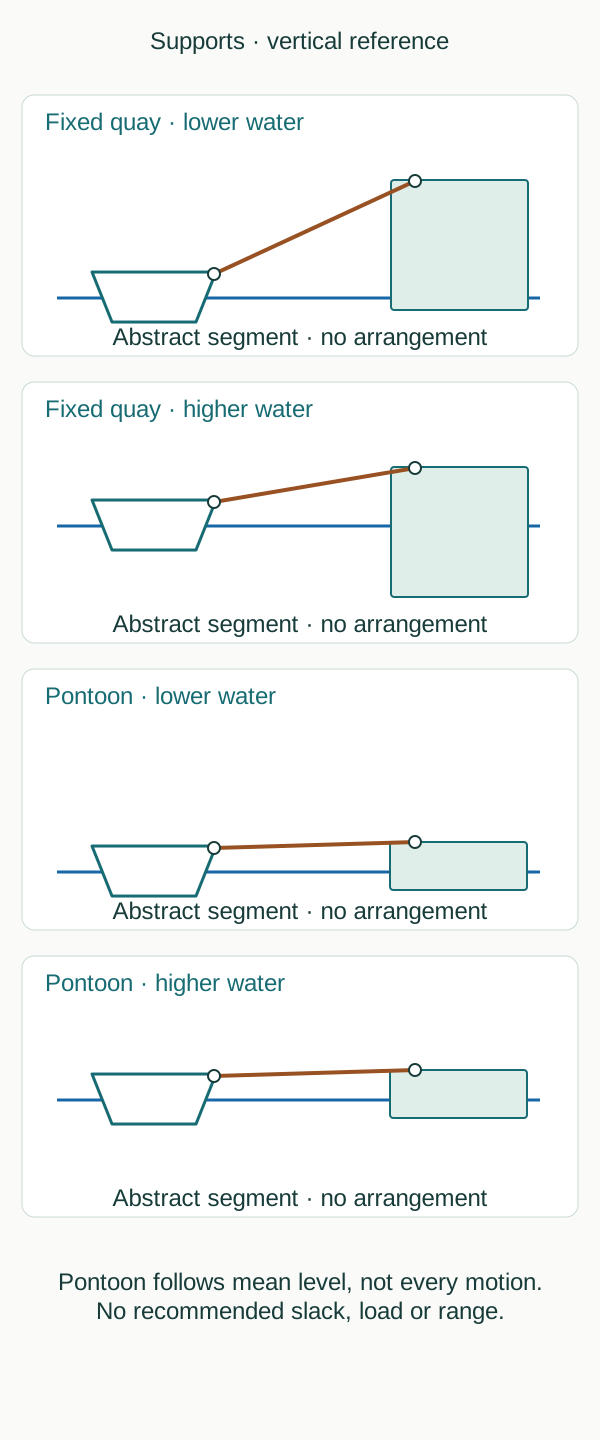
Original conceptual schematic, not to scale; fictional cases, not a manoeuvre procedure.
insideSailOriginal insideSail artwork — all rights reservedEnlarge the diagram
Separate the structure from the water surface
A fixed quay retains its height relative to land while water level can vary. A floating pontoon follows that level within its system’s behaviour and limits.
The boat also floats but is not rigidly joined to the pontoon. The educational distinction is the vertical reference: a water-level change affects boat–fixed-quay geometry differently from the mean boat–floating-pontoon relationship.
The diagram shows two hypothetical water levels without a tide prediction or numerical height. Positions are separate states, not animation of an actual berth.
At the fixed quay, the shore support keeps its elevation while the boat point rises or falls. At the pontoon, both follow the mean change.
Nothing in the drawing guarantees that a structure accommodates every possible local range.
An inclined segment is longer
Consider an abstract line between two points with unchanged horizontal separation. Increasing their vertical difference increases the straight distance between them.
This is geometry, not an instruction to adjust a loaded line. In a real system, extension, initial slack, motion and leads alter the response.
The drawing alone cannot establish that a line will fail or that it keeps the boat correctly positioned.
Force direction also changes with inclination. A segment with a vertical component can transmit load in that direction to its supports.
A line’s name does not remove that effect. Capacity depends on rope, fittings, structure and conditions rather than one angle.
The lesson supplies no permissible load, maximum angle or universal slack allowance; those values would require information absent from these abstract points.
Floating pontoon does not mean a motionless relationship
Waves, wash, people moving and structural response can make boat and pontoon move differently. The boat may roll, move along or away; the pontoon may respond differently or reach a movement limit.
The simplification of both following mean level must not erase relative motions. Gangways, piles and other fixed parts may also be close to a floating structure.
Fender contact and access between boat and structure belong to this geometry. A comfortable transfer in one state may have a different height difference later.
That is not converted into instructions to jump or board during movement. Recognition supports communicating conditions and planning with the berth authority.
Simplified geometry does not establish safe access for every person or water state.
A record needs conditions, not just a photograph
A useful description identifies fixed or floating structure, observed water state, contact points and present motion. It separates published prediction from measurement or observer estimate.
Two differently angled photographs do not alone establish an exact vertical change. The drawing is a controlled hypothetical comparison: references stay fixed to expose the mechanism without pretending to represent the scale of a European marina.
If only the water-level change is reversed while supports remain defined, inclination changes in the opposite sense. There is no need to claim that every high- or low-water situation has the same problem: initial vertical separation matters too.
The exercise compares a declared pair of states while retaining the other references, making the change explainable without turning it into a local prediction or a universal rope-length recommendation.
MCA guidance supports assessing the system and force leads; the vertical comparison is an explicitly declared geometric deduction. Commercial-ship procedures and yacht line recipes are not imported.
Recognising that supports move differently is the starting point. Selecting and verifying an actual arrangement requires knowledge of berth, range, vessel, materials and responsibilities, with appropriate competence.
Sources and references
- Boat Fender Guide ↗
Polyform US · General-guide qualification; Fendering tips; protection between hull and dock and risk of swinging onto dock.
Manufacturer advice within its product context. Sizing/count/pressure/line-diameter tables and configurations not reproduced or generalised.
Checked on - MGN 592 (M+F) Amendment 2 — anchoring, mooring, towing or hauling equipment ↗
Maritime and Coastguard Agency · Sections 4.1–4.6 system loads and line direction; 5.1–5.5 bights and snap-back, whole-area risk and redirected leads.
Official guidance directly consulted for hazards and geometry; commercial procedures, turns, stoppering methods and loads not imported as yacht instructions.
Checked on
Keep discovering
The next piece of the puzzle
Discuss this concept
Loading the conversation…