By insideSail
Published without technical review · version 2 ·
Tacking and gybing: reading a sloop sequence
Successive states show wind, bow or stern crossing and sheet changes.
In this guide
We follow a conventional sloop with mainsail and a headsail controlled by two sheets. It has no self-tacking headsail, spinnaker or headsail boom.
Exercise wind direction remains constant and there is no current. The diagram assembles successive states rather than a track or timeline.
This makes changing sides and controlled components understandable without pretending all rigs use one sequence.
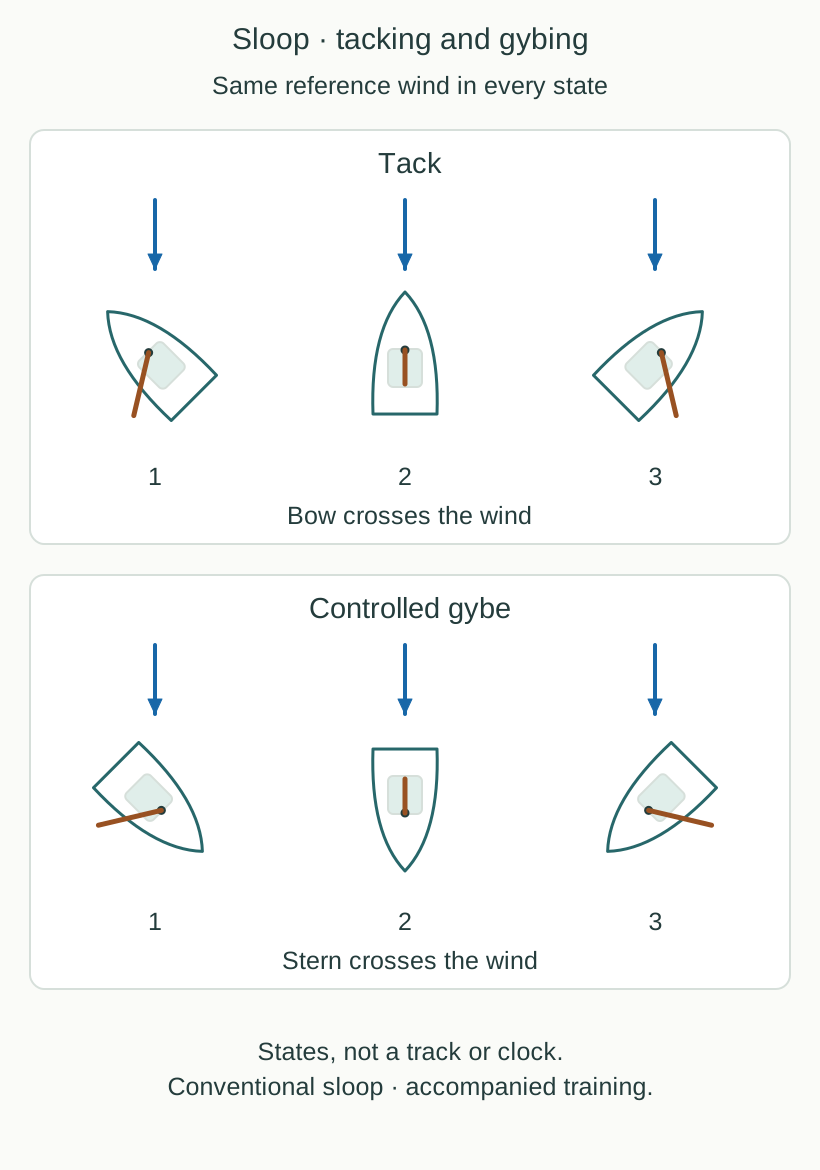
Original teaching illustration; bounded case, not to scale. See the lesson’s assumptions and limits.
insideSailOriginal insideSail artwork — all rights reservedEnlarge the diagram
Tacking: the bow crosses the wind
Before beginning, the helm checks space and traffic and agrees crew tasks. Initially the headsail draws and its leeward sheet controls it.
Heading up brings the bow towards the direction wind comes from. The sail loses pressure and luffs.
The previously loaded sheet is released under control as the sail stops drawing; premature release can remove drive before the boat crosses the wind.
The bow crosses the wind and the boat establishes the new tack. The formerly windward sheet becomes the working sheet and is trimmed for the new point of sail.
Steering and trim restore controlled sailing rather than stop with the bow still head-to-wind. Command words vary; agree preparation and execution terms beforehand.
“Ready” is meaningful only when the recipient understands task, rope and a position from which it can be performed.
Gybing: the stern crosses the wind
In a controlled gybe, mainsail and boom change sides as the stern crosses the wind direction. Crew are warned beforehand and keep clear of boom and mainsheet movement appropriate to the system.
In a conventional configuration suitable for training, the mainsheet is brought in to control boom transfer; the boat crosses the downwind sector under control and the sheet is then eased for the new point of sail. Allowing a violent transfer and only then trying to catch the sheet is not control.
This is an example for accompanied training. A preventer, specialist sail, different rig or strong conditions alter preparation and may make the manoeuvre unsuitable.
A brake or additional line is not an installation to copy from this diagram. Even with apparently controlled boom movement, the mainsheet can sweep another area.
The rest of the deck is not coloured as safe. The official Buccaneer of Upnor case demonstrates consequences of an accidental gybe without being reconstructed here.
Compare before and after
Sources and references
- Do you know your points of sail? ↗
Royal Yachting Association · Sail Trim; Sailing Upwind; wind-relative points of sail.
Official page directly read. Its ideal angle and fastest-point generalisations are not universalised.
Checked on - Teaching Fundamentals, e-TF V1.3 April 2014 ↗
US Sailing · Printed pp.68 and 70: tacking a jib and premature release. Only these physical teaching examples, not historical psychological claims, are used.
Official PDF passages directly read. No racing-rule or current course endorsement is claimed.
Checked on - Accidental gybe on cruiser racing yacht Buccaneer of Upnor with loss of 1 life ↗
Marine Accident Investigation Branch · Synopsis and Action taken: boom/mainsheet exposure and accidental gybe.
Official landing-page summary read. The fictional sequence is not a reconstruction of this accident.
Checked on - How to brief your crew ↗
Royal National Lifeboat Institution · 4 October 2019: role assignment, familiarisation and timely briefing before coming alongside.
Official article read. Original small-crew example is neither an RNLI exercise nor certification.
Checked on
Keep discovering
The next piece of the puzzle
Discuss this concept
Loading the conversation…