By insideSail
Published without technical review · version 2 ·
Tacking and gybing: prepare people and control change
Changing tack has known geometry but specific execution.
In this guide
Tacking passes the bow through the wind; gybing passes the stern through it. Knowing that geometry establishes no control of sails, sheets or people.
Boom and lines can change sides with injurious energy. An unintended gybe is more than badly drawn geometry: it can surprise the crew.
This lesson prepares communication and supervised practice without a helming-and-sheeting sequence for every rig.
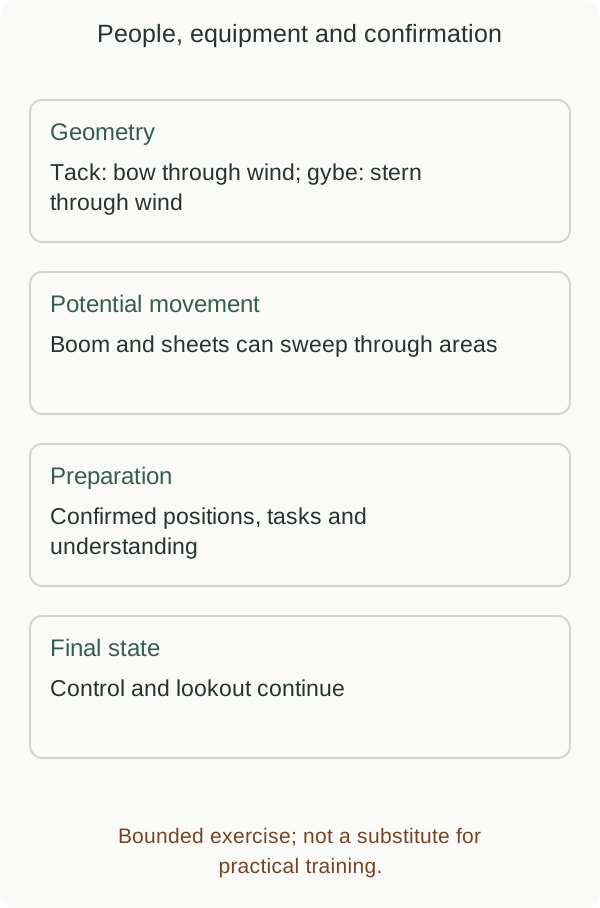
Bounded exercise; not a substitute for practical training.
insideSailOriginal insideSail artwork — all rights reservedEnlarge the diagram
Paths of people and equipment
Locate boom, mainsheet, traveller, winches and relevant lines aboard. Boom sweep is not merely its pre-manoeuvre position.
Sheets can move and tighten bights, trapping clothing or hands. Crew need suitable positions and paths defined during training with actual configuration.
A cockpit enclosure makes no entire area automatically protected. The diagram identifies potential movement without a universal certified safe zone.
Anticipation begins with relative wind, conditions, space and lookout. Helming attention should not transfer to a line problem without appropriate delegation.
Actual capability determines tasks. Someone unable to recognise a sheet is not made competent by hearing “ready to tack”.
Briefing reveals uncertainty, confirms capacity and permits a simpler task or postponement. A manoeuvre should not begin merely because nobody had time to respond.
Warning, confirmation and agreed execution
- Identify manoeuvre and conditions with the instructor.
- Assign tasks and positions outside identified hazards.
- Request and hear readiness from relevant participants.
- Use the procedure taught for that boat and system.
- Confirm final state while maintaining control and lookout.
Words vary between schools and crews; their purpose is shared understanding. Reporting unreadiness must be permitted.
Unexpected wind or traffic may require interruption before commitment. Completing a planned sequence is no reason to continue unsafe practice.
Preparation considers unintended change and appropriate exposure reduction. Preventers require specific installation and operation; this lesson authorises no improvised mid-boom or guardrail attachment.
A tack may not complete as planned, and a gybe can change state faster than expected. Response depends on space, yacht, sails and competence rather than one correction for every failure.
In suitable conditions an instructor plans recovery of control. Learning neither deliberately surprises a crew member nor simulates a boom strike.
Language and recognition can be assessed ashore before waterborne execution.
Ask each participant to point out an equipment sweep without moving it. Compare the indicated area with people and lines.
Then discuss lookout responsibility and how to report misunderstanding. This prevents rehearsing speed before discovering missing understanding.
Final confirmation concerns vessel state rather than merely the boom changing sides; conditions, control and resources remain relevant after geometry changes. Equipment intended to limit movement authorises no lapse in steering or lookout.
Connection installation and consequences need specific documentation and assessment; there are no preventer-fitting instructions here. A verbal warning or accessory does not eliminate unintended gybes.
An exercise can reveal a blind spot without deliberately creating the movement that made it hazardous, preserving the distinction between recognition and supervised performance.
Sources and references
- Hints and Advice on Rigging and Tuning ↗
Seldén Mast · Printed pp.12–14 Running rigging; p.56 Slab-reefing boom.
Official PDF downloaded and selected full pages read on 11 October 2026. Device-specific slab reef reference, not a universal recipe. No copied instructions, tuning, preventer installation or specified line length.
Checked on - Yacht sailing and motorboating ↗
RNLI · Safety checklist: training, briefing, weather and shore contact.
Read for preparation and bounded training. No comparative statistics or emergency procedure copied.
Checked on
Keep discovering
The next piece of the puzzle
Discuss this concept
Loading the conversation…