By insideSail
Published without technical review · version 2 ·
Adjustment and reefing: identify, act, confirm
Recognise the system before touching a control and observe after changing it.
In this guide
Adjustment changes sail shape or position; reefing changes utilised area. They can relate without being equivalent.
Excessive demands are not solved by repeatedly working a sheet, and smaller sail area does not prove correct preparation. Execution depends on rig, sail, boom, lines and installed equipment.
This lesson structures supervised practice and specific-system reading without transferring a reefing sequence to another furler or prescribing universal tuning.
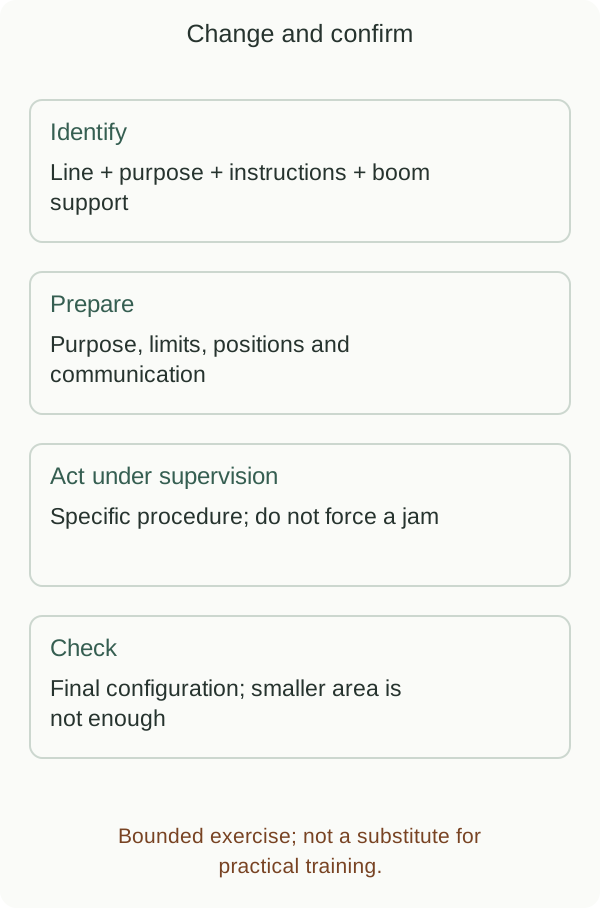
Bounded exercise; not a substitute for practical training.
insideSailOriginal insideSail artwork — all rights reservedEnlarge the diagram
A line identified end to end
Follow a control to the element it changes. Old labels or colours establish no present function, especially after modifications.
Halyard, sheet, outhaul and reefing line have different effects. Routing includes clutches, sheaves and winches requiring known compatibility and operation.
In unloaded training, participants identify a line and explain its relationship. Pulling harder is not a way to discover whether it was correct.
The boom needs support when the sail ceases to provide it. The consulted Seldén manual shows a slab-reefing example with topping lift and specific controls, distinguishing single-line and furling systems too.
That example does not automatically apply to rigid support or another sail. Identify actual arrangement and instructions before practice.
Specific teaching determines load and motion management; this chapter never instructs releasing a halyard without understanding boom weight.
One change, an intelligible observation
Under suitable conditions, an instructor bounds the variable, expected effect and limits. Changing several controls together makes attribution difficult.
Retain lookout rather than stare exclusively at telltales or displays. Boat movement, wind and waves also change observations.
A result may follow a gust rather than the control. Learning recognises that uncertainty instead of turning an observed improvement into guaranteed performance percentage.
- Understand the need and crew workload limit.
- Identify system, instructions, support and routing.
- Prepare tasks, positions and communication before changing state.
- Perform the specifically taught procedure without forcing a jam.
- Confirm final configuration and vessel control.
A sticking control can involve routing, load or equipment faults. Winch leverage diagnoses nothing and authorises no exceeded limits.
Interruption and competent assistance avoid worsening the situation. Sail reduction needs anticipation and suitable margin considering forecast and crew; one wind number fits no universal fleet.
Editorial independence explains criteria instead of pretending to know the reader’s installation.
A practice sheet can separate identified control, expected effect and actual observation. Recognising a sheet describes a relationship with sail position without proving adequate tension or configuration.
Add conditions capable of producing the same observation. If the participant cannot explain boom support, that gap prevents considering the sequence understood.
Memorising colours completes no task. The instructor checks system relationships, communication and final state.
Modification may have changed routing since an old manual, requiring current assembly documentation. Even one manufacturer supplies distinct boom systems.
This justifies retaining identity and source instead of adding a vague disclaimer after presenting a universal recipe. Where the right document remains uncertain, the learning outcome is that unresolved identification, not apparent competence gained by comparing another boat’s photographs.
Storm sails, spinnakers, Code Zero and failed-furler recovery require separate lessons outside this practice introduction. Drawings create neither certified installation nor servicing intervals.
Sources and references
- Hints and Advice on Rigging and Tuning ↗
Seldén Mast · Printed pp.12–14 Running rigging; p.56 Slab-reefing boom.
Official PDF downloaded and selected full pages read on 11 October 2026. Device-specific slab reef reference, not a universal recipe. No copied instructions, tuning, preventer installation or specified line length.
Checked on - Rope care advice ↗
Marlow Ropes · Care in Use; Terminations; Inspection and Retirement.
Official page directly consulted. No cleaning chemistry, temperature, numerical load reduction, universal lifespan or splicing recipe. Appearance alone is not a strength assessment.
Checked on - Yacht sailing and motorboating ↗
RNLI · Safety checklist: training, briefing, weather and shore contact.
Read for preparation and bounded training. No comparative statistics or emergency procedure copied.
Checked on
Keep discovering
The next piece of the puzzle
Discuss this concept
Loading the conversation…