By insideSail
Published without technical review · version 2 ·
Boat care: observe, record and bound the work
An observation can justify assessment without justifying an improvised repair.
In this guide
Boat care includes recognising changes, preserving documents and seeking assessment when needed. Observation is not always diagnosis and visually simple work is not always safe.
Worn rope, heating components or water in a new location differ from conclusions about cause. This lesson structures observation and records without dismantling, load, operating machinery or chemical application.
Intervention needs particular equipment, competence and instructions.
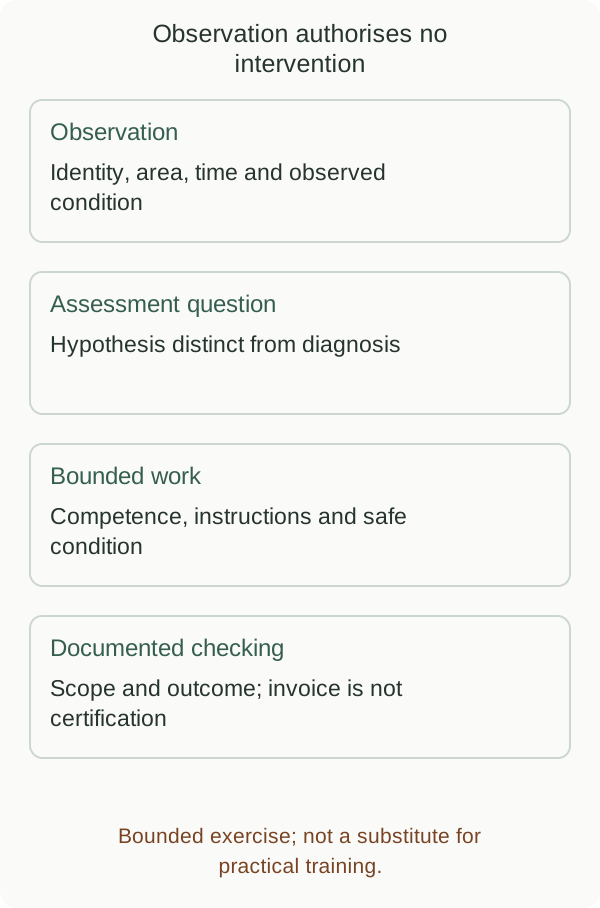
Bounded exercise; not a substitute for practical training.
insideSailOriginal insideSail artwork — all rights reservedEnlarge the diagram
Identity, location and observed condition
Useful records identify item and area, date and circumstances. “Damaged rope” says less than a located observation with known product and safely obtained photograph.
Photography should not require hands near moving parts. This exercise authorises neither opening a cover nor removing an installed part merely for documentation.
Description helps a competent assessor identify the question while retaining unseen areas and uncertainty.
Marlow distinguishes external, chemical and internal effects; appearance alone establishes no remaining strength. A photograph without visible damage proves no fitness.
No fixed lifespan covers every rope and no percentage describes every knot. Identity, history and instructions support assessment.
Relevant suspicion requires appropriate procedures and competence for continued service decisions; the exercise does not prescribe a load test to discover whether it still holds.
Define work before beginning
A task needs purpose, identified system, instructions, resources and boundaries. Electrical energy, motion, pressure, heat, fuel and loads can remain despite apparently inactive controls.
Making equipment safe is specific and must be understood by those intervening. This lesson gives no generic battery-disconnection or valve sequence.
A competent person verifies safe conditions and organises work; information gathering does not justify crossing that boundary.
| Field | Record example |
|---|---|
| Observation | Located change without assumed cause. |
| Hypothesis | A possibility explicitly labelled. |
| Assessment | Assessor, scope, document and date. |
| Intervention | Documented component and work, not general approval. |
| Subsequent verification | Criterion, result and remaining limits. |
A new component does not automatically close a fault. Compatibility, installation and outcome need assessment.
An invoice proves a transaction, not that the whole system was checked. OwnerBoat histories keep declarations, documents and assessments separate.
Owners can share work while withholding personal provider data or complete invoices. Community experience helps identify questions, but popular comments do not turn a remedy into an approved procedure.
An observation form needs a “not observed” column. Photographing an exterior component establishes no internal condition, and absent reports are not absent problems.
A professional can identify useful safely obtainable data without asking an owner to dismantle an assembly for a better image. Where work occurs, retain original documents and proportionate scope.
Component replacement proves no assessment of everything else. “Observed”, “assessed”, “work completed” and “verification recorded” answer different questions; uploading an invoice does not grant the last status.
Useful histories retain responsibility and unresolved questions across ownership changes without exposing private contacts or inventing certification chains. The same separation prevents commercial recommendation becoming technical evidence of necessity, preserving an honest distinction between what a supplier offered and what a competent assessment actually concluded.
Preparation ends with explicit open questions and responsibilities, not necessarily every box ticked. Structural repair, gas, electricity, cooling and fitting installation require distinct subjects.
This lesson grants none of those competencies. Its goal is better information for assessment and work.
Sources and references
- Hints and Advice on Rigging and Tuning ↗
Seldén Mast · Printed pp.12–14 Running rigging; p.56 Slab-reefing boom.
Official PDF downloaded and selected full pages read on 11 October 2026. Device-specific slab reef reference, not a universal recipe. No copied instructions, tuning, preventer installation or specified line length.
Checked on - Rope care advice ↗
Marlow Ropes · Care in Use; Terminations; Inspection and Retirement.
Official page directly consulted. No cleaning chemistry, temperature, numerical load reduction, universal lifespan or splicing recipe. Appearance alone is not a strength assessment.
Checked on - V 1–V 6 Windlass — 65001201 Issue 11 ↗
Lewmar · Printed p.3 §2 Safety Notice; §4.3 gypsy/rode suitability.
Official linked English manual directly consulted. Hazards and distinction between windlass and independent securing point; no installation or electrical procedure.
Checked on
Keep discovering
The next piece of the puzzle
Discuss this concept
Loading the conversation…