By insideSail
Automated technical check · version 2 ·
Seamanship: connect what you see with what happens
A map of names, functions, movements and practical learning.
In this guide
When you first step onto a sailboat, the number of lines, fittings and controls can be striking. It may seem that everything must be memorised before anything makes sense.
A more useful starting point is to look at relationships. A sheet connects to a sail or boom; a block redirects a line’s path; a fender lies between surfaces that can approach one another.
Names make these relationships easier to describe.
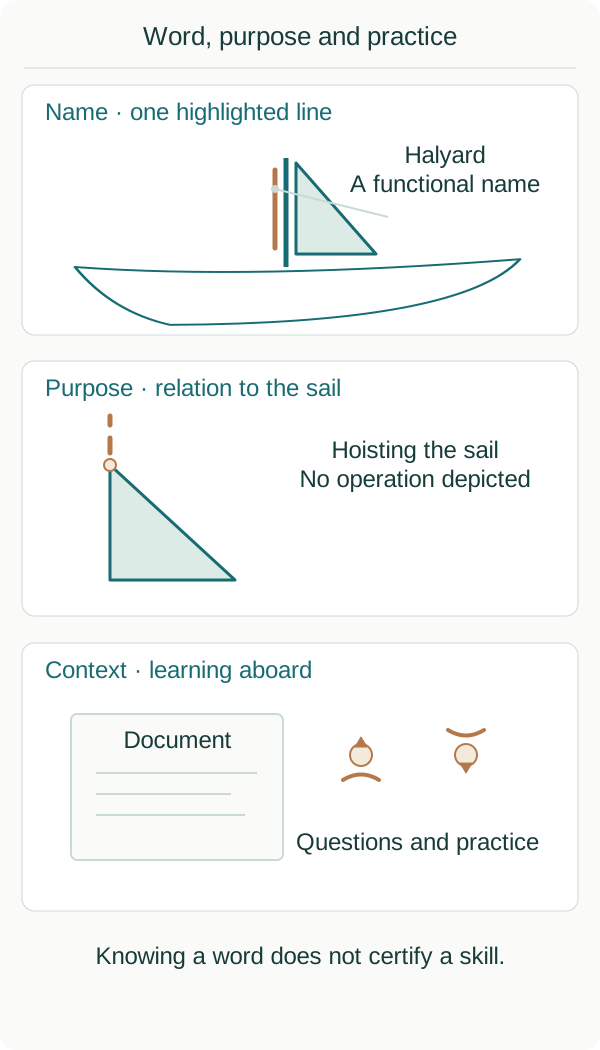
Names, jobs and learning context. Not a competence assessment.
insideSailOriginal insideSail artwork — all rights reservedEnlarge the diagram
Four questions that organise the whole
What is it? This asks about identity: line, block, sail or rudder.
What does it do? This asks about function: transmitting tension, leading a path or interacting with a fluid.
What is it connected to? This asks about the system, because a component rarely works alone.
What does it move relative to? This asks about the reference frame.
A bow can point one way while water movement carries the boat in a different direction over the ground.
These questions also separate similar-looking things. Two lines can share a colour and perform different jobs.
A steering wheel and a winch both include circular elements, but one commands steering while the other helps create line tension. Recognising a silhouette is a beginning; understanding function lets you follow an explanation when a component looks different or appears on another boat.
An example: three elements, three jobs
Observing and explaining are different steps
An observation describes something identifiable: a sail is furled, a line passes through a particular fitting or the boat lies alongside a pontoon. An explanation proposes the relationship that makes the observation meaningful.
A decision adds an objective and context. “The sail is furled” does not automatically answer “why was it furled?”
or “what should the crew do now?”. Separating these levels improves conversation without requiring advanced vocabulary.
There is also a difference between a state and a change. A fender beside the hull shows a position at one instant.
A sequence of positions can reveal relative movement but does not measure contact force. A boat on a constant heading can still accelerate; another at constant velocity can experience forces that balance.
Position, velocity and force provide different information even when they describe the same event.
From understanding to learning aboard
Sailing training combines theory and practice because a relationship understood in a diagram must be recognised in a real setting. Aboard, scale, movement, noise, task organisation and communication become part of learning.
An instructor can connect a name to an actual component and its function to the installed system. Reading beforehand makes explanations more accessible; guided experience adds abilities that text and drawings cannot demonstrate.
This manual develops relationships progressively: first rope and its construction, then connections and contact, then the boat in water and finally air and water together. Central definitions remain available without a separate glossary to memorise.
When an unfamiliar word appears, identify the component or reference frame first. Many difficulties disappear when “that moved” becomes “the boom changed position relative to the hull”.
Takeaways
- Identity, function and connection answer different questions.
- Movement always needs a reference frame.
- Conceptual understanding prepares practical learning; it does not establish operating competence.
Sources and references
- Sail cruising courses ↗
Royal Yachting Association · Practical courses; Courses ashore.
Theory/practice distinction only; no syllabus, certification or legal equivalence imported.
Checked on - Hints and Advice on Rigging and Tuning ↗
Seldén Mast · Printed pp.12–14 Running rigging; p.56 Booms.
Selected official PDF sections consulted on 10 October 2026. Component/control identity only; no tuning, loading or reefing instructions. Edition year not inferred.
Checked on
Keep discovering
The next piece of the puzzle
Discuss this concept
Loading the conversation…