Por insideSail
Revisão editorial assistida por IA · versão 3 ·
Luzes de um veleiro: vela, motor e fundeio
O mesmo casco pode exigir conjuntos diferentes; a lanterna tricolor não é uma luz de mastro.
Neste guia
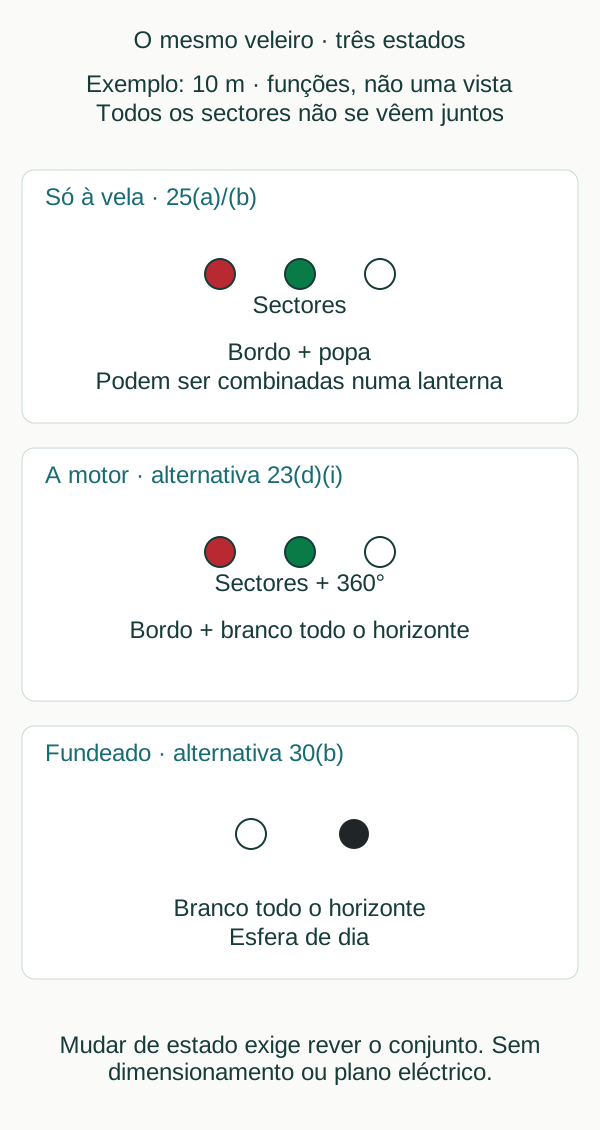
Esquema original de interpretação; funções e referências declaradas. Sem escala, instalação aprovada ou percurso operacional.
insideSailOriginal insideSail artwork — all rights reservedAmpliar o esquema
Imagine um veleiro fictício com dez metros de comprimento. Ao navegar só à vela, usar o motor para propulsão ou fundear, muda o estado relevante.
As luzes devem corresponder a esse estado. Não se ligam todas as lanternas para ficar mais visível: certas combinações confundem a mensagem e outras são expressamente incompatíveis.
Comece pelas Regras 3, 20 e 21; depois escolha a disposição de 23, 25 ou 30. O desenho representa conjuntos de funções, não cablagem nem instalação aprovada.
Só à vela: bordo e popa
A Regra 25(a) prescreve luzes de bordo, vermelha a bombordo e verde a estibordo, e luz branca de popa. Para um navio à vela com menos de vinte metros, 25(b) permite combiná-las numa lanterna no topo do mastro ou perto dele, onde melhor se veja.
Chama-se habitualmente tricolor, mas as três cores permanecem em sectores: não são três luzes todo o horizonte. Uma só lanterna física pode executar três funções definidas.
A alternativa adicional de 25(c) é vermelho sobre verde, ambos todo o horizonte, no topo ou perto dele, além do conjunto de 25(a). Não pode ser usada com a lanterna combinada de 25(b).
Vermelho sobre verde não substitui, sozinho, bordo e popa. Para menos de sete metros, 25(d)(i) exige as luzes prescritas se praticável; se não as mostra, exige ter prontamente à mão lanterna eléctrica ou acesa branca e exibi-la em tempo suficiente para prevenir abalroamento.
Não transferimos essa alternativa para um veleiro de dez metros.
A motor: acrescentar uma função não é ligar tudo
Pela Regra 23(a), propulsão mecânica a navegar mostra luz de mastro, bordo e popa; o segundo mastro a ré e mais alto torna-se obrigatório a partir de cinquenta metros, facultativo abaixo. Mastro significa aqui branco com sector de 225 graus, não localização no topo físico.
Um tricolor de vela não substitui esta função. A Regra 23(d)(i) permite, para menos de doze metros, branco todo o horizonte e bordo em lugar do conjunto de 23(a).
Não é a regra normal de um barco de doze metros exactos.
Fundeio e limites da figura
A Regra 30(a) prescreve branco todo o horizonte a vante e outro mais baixo a ré, mas 30(b) permite um só branco todo o horizonte para menos de cinquenta metros, onde melhor se veja. A esfera é a marca diurna.
A excepção de menos de sete metros em 30(e) depende também do lugar, não apenas do comprimento. Estar encalhado é diferente e pode acrescentar sinais.
Os alcances mínimos vêm de 22; posição, separação, sectores e aprovação do Anexo I.
As cores e funções do esquema são exactas para os casos declarados; o tamanho dos pontos não é intensidade, alcance ou dimensão de lanterna. Os sectores não são todos visíveis da mesma posição.
Esta leitura prepara a verificação do plano de luzes do exemplar concreto com documentação técnica e autoridade competente. Não certifica uma instalação pela fotografia, nem deduz responsabilidade num encontro apenas por uma luz branca observada.
Fontes e referências
- RIEAM / COLREGs — Rule 25: Sailing vessels underway and vessels under oars ↗
Instituto Hidrográfico / International Maritime Organization · Rule 25, normative Portuguese printed p.39 (PDF p.45); International English cross-check in USCG handbook.
Rule 25; IH normative Portuguese printed p.39, PDF p.45; English International column cross-check. Individual provision commencement not established: valid_from remains null.
Consultada em - RIEAM / COLREGs — Rule 20: Application of lights and shapes ↗
Instituto Hidrográfico / International Maritime Organization · Rule 20, normative Portuguese printed p.29 (PDF p.35); International English cross-check in USCG handbook. Rule 21, normative Portuguese printed p.29 (PDF p.35); International English cross-check in USCG handbook.
Rule 20; IH normative Portuguese printed p.29, PDF p.35; English International column cross-check. Individual provision commencement not established: valid_from remains null. Rule 21; IH normative Portuguese printed p.29, PDF p.35; English International column cross-check. Individual provision commencement not established: valid_from remains null.
Consultada em - USCG amalgamated rules — International current web cross-check ↗
United States Coast Guard Navigation Center · International/shared Rules 3,20–30,32–35; International Annexes I–III. International-only wording identified by angle-bracket legend; all Inland insertions excluded. Rule35(j)/(k) compared with IH normative Portuguese printed55/PDF61 and English appendix89–90/PDF95–96.
Directly read 11 October2026 alongside freshly fetched corrected-August2024 official handbook. Current page confirms under12 paragraph(j) and pilot(k); Portuguese IH agrees; its English appendix differs. Access is not qualified legal approval. No unsupported exact consolidation date assigned.
Consultada em - RIEAM / COLREGs — Rule 23: Power-driven vessels underway ↗
Instituto Hidrográfico / International Maritime Organization · Rule 23, normative Portuguese printed p.31 (PDF p.37); International English cross-check in USCG handbook.
Rule 23; IH normative Portuguese printed p.31, PDF p.37; English International column cross-check. Individual provision commencement not established: valid_from remains null.
Consultada em - RIEAM / COLREGs — Rule 2: Responsibility ↗
Instituto Hidrográfico / International Maritime Organization · Rule 3, normative Portuguese printed p.3 (PDF p.9); International English cross-check in USCG handbook.
Rule 3; IH normative Portuguese printed p.3, PDF p.9; English International column cross-check. Individual provision commencement not established: valid_from remains null.
Consultada em - RIEAM / COLREGs — Rule 22: Visibility of lights ↗
Instituto Hidrográfico / International Maritime Organization · Rule 22, normative Portuguese printed p.30 (PDF p.36); International English cross-check in USCG handbook.
Rule 22; IH normative Portuguese printed p.30, PDF p.36; English International column cross-check. Individual provision commencement not established: valid_from remains null.
Consultada em - COLREGs Annex I — Positioning and technical details of lights and shapes ↗
Instituto Hidrográfico / International Maritime Organization · Annex I; printed p.65, PDF p.71; International cross-check USCG.
Annex I, IH printed p.65 (PDF p.71); cross-check International annex in USCG handbook. Installation/approval is not taught. International/Inland distinction checked in the USCG PDF: International §3(a) half-length/100m agrees with IH; the quarter-length/50m value belongs to U.S. Inland and is not imported. No dimensional installation prescription is reproduced.
Consultada em - RIEAM / COLREGs — Rule 29: Pilot vessels ↗
Instituto Hidrográfico / International Maritime Organization · Rule 30, normative Portuguese printed p.49 (PDF p.55); International English cross-check in USCG handbook.
Rule 30; IH normative Portuguese printed p.49, PDF p.55; English International column cross-check. Individual provision commencement not established: valid_from remains null.
Consultada em
Referências regulamentares
- Regra 21 / Rule 21 — Definições de luzes / Definitions of lights ↗
COLREG 1972 as amended; IH 9th edition September 2025 / International cross-check August 2024 · International Maritime Organization · International convention; national/local implementation must be checked
Verificada em - Annex I — Positioning and technical details of lights and shapes ↗
COLREG 1972 as amended; consolidated documents consulted 11 October 2026 · International Maritime Organization · International; flag authority approval
Verificada em - Regra 22 / Rule 22 — Alcance das luzes / Visibility of lights ↗
COLREG 1972 as amended; IH 9th edition September 2025 / International cross-check August 2024 · International Maritime Organization · International convention; national/local implementation must be checked
Verificada em - Regra 30 / Rule 30 — Navios fundeados e navios encalhados / Anchored vessels and vessels aground ↗
COLREG 1972 as amended; IH 9th edition September 2025 / International cross-check August 2024 · International Maritime Organization · International convention; national/local implementation must be checked
Verificada em - Regra 20 / Rule 20 — Aplicação de luzes e balões / Application of lights and shapes ↗
COLREG 1972 as amended; IH 9th edition September 2025 / International cross-check August 2024 · International Maritime Organization · International convention; national/local implementation must be checked
Verificada em - Regra 23 / Rule 23 — Navios de propulsão mecânica a navegar / Power-driven vessels underway ↗
COLREG 1972 as amended; IH 9th edition September 2025 / International cross-check August 2024 · International Maritime Organization · International convention; national/local implementation must be checked
Verificada em - Regra 3 / Rule 3 — Definições gerais / General definitions ↗
COLREG 1972 as amended; IH 9th edition September 2025 / International cross-check August 2024 · International Maritime Organization · International convention; national/local implementation must be checked
Verificada em - Regra 25 / Rule 25 — Navios à vela a navegar e navios a remos / Sailing vessels underway and vessels under oars ↗
COLREG 1972 as amended; IH 9th edition September 2025 / International cross-check August 2024 · International Maritime Organization · International convention; national/local implementation must be checked
Verificada em
Continue a descobrir
A próxima peça do puzzle
Conversa sobre este conceito
A carregar a conversa…